
TL;DR — Direct answer: PET bottle blowing needs two things that rarely sit together: air at 30 to 40 bar, and air with no oil in it at all, because the bottle that holds a drink cannot carry compressor oil. The standard answer is a two-stage system — a low-pressure oil-free screw compressor feeding a high-pressure booster — rather than a single machine doing everything. That split keeps oil out of the product, lets each stage run at its efficient pressure, and gives the plant a high-pressure circuit that does not punish the rest of the factory's 7 bar air.
A PET blowing line is unforgiving about air quality in a way a workshop never is. A single oil event does not just dirty a tool; it contaminates bottles, triggers a recall conversation, and puts the plant's food-safety audit at risk. At the same time the blowing process demands 30 to 40 bar, far above the 7 to 8 bar the rest of the packaging hall uses, so the air system has to serve two pressures without letting either compromise the other.
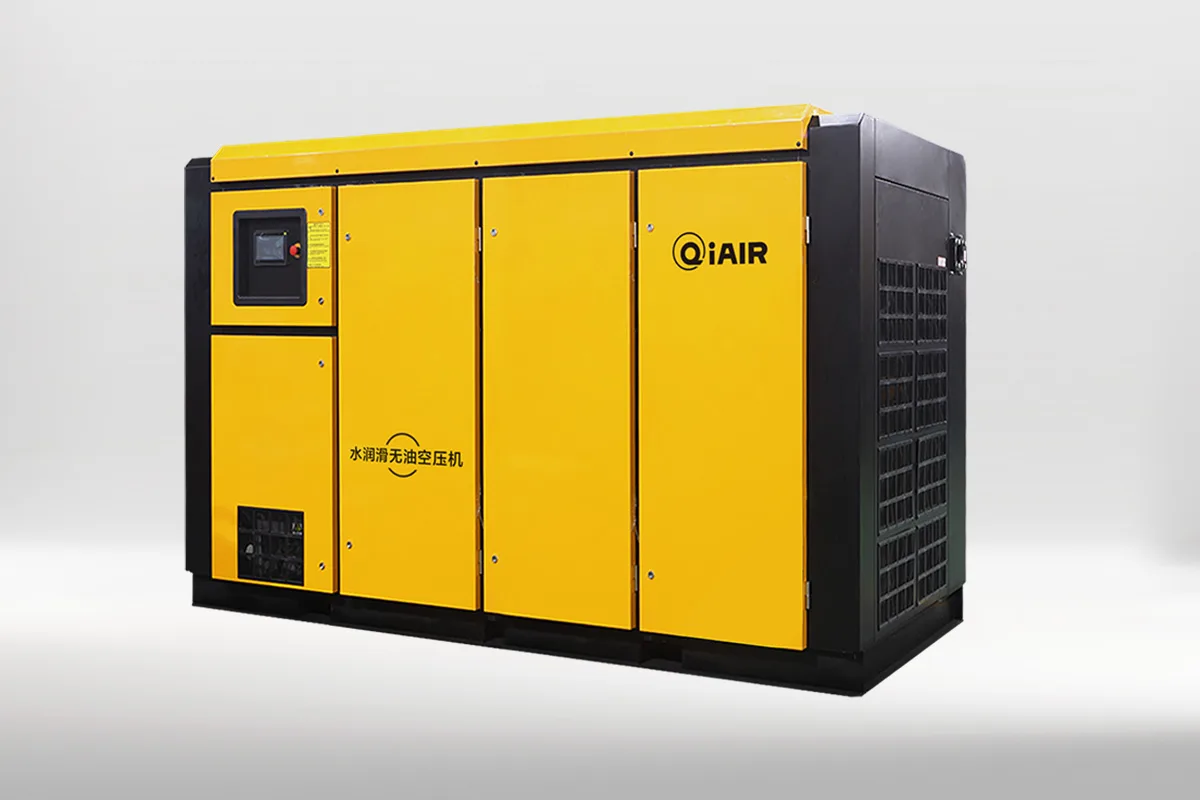
QiAir, a Chinese manufacturer and supplier of screw air compressors, advises beverage and packaging customers on exactly this split: low-pressure oil-free air for general use, and a dedicated high-pressure circuit for blowing. The design below explains why that split, not a single high-pressure machine, is the configuration that holds up in production.
Why two stages beat one heroic machine
A single-stage compressor reaching 40 bar from atmosphere works at a compression ratio that drives discharge temperatures up, wears components fast, and wastes energy on every cubic metre. Splitting the job — an oil-free screw stage to around 7 to 10 bar, then a booster to 30 to 40 bar — keeps each stage near its efficient ratio, and the intercooling between stages removes much of the heat that would otherwise degrade oil-free seals and coatings.
Oil-free matters at the first stage, not just at the bottle. Any oil introduced upstream must be removed downstream, and no filter removes oil vapour completely, so starting oil-free is the only way to guarantee oil-free product air. For beverage plants this is also an audit argument: an oil-free compressor plus documented air-quality testing to ISO 8573-1 Class 0 or Class 1 for oil is a far stronger position with a food-safety auditor than an oil-injected machine plus a filter claim.
Sizing the blowing circuit on bottles, not on averages
Size on the blowing machine's rated consumption at its rated pressure, plus the air used by preform handling, conveyor and labelling on the same circuit — and then add the surge. Blowing is cyclic: each mould cycle draws a sharp pulse of high-pressure air, so the high-pressure receiver and the booster capacity must handle the pulse rate at maximum line speed, not the average over an hour. A line rated at 20,000 bottles per hour with a 2-litre bottle does not need the same air as one running 1-litre bottles at the same speed, and that bottle-size arithmetic is where undersizing usually hides.
Energy follows the same logic. High-pressure air is expensive air — roughly three times the energy per cubic metre of 7 bar air — so leaks in a 40 bar circuit cost three times as much as leaks at workshop pressure, and a single leaking high-pressure fitting can quietly cost thousands a year. High-pressure lines deserve stainless or properly rated steel pipe, leak surveys on a fixed schedule, and pressure testing after any modification, because a 40 bar leak is a safety event as well as an energy loss.
- Size on peak bottle rate and bottle volume, not hourly averages.
- Budget a high-pressure receiver large enough to smooth mould-cycle pulses.
- Survey 40 bar lines for leaks on a fixed schedule — leaks cost triple here.
Reliability, maintenance and the export question
Oil-free machines have different maintenance than oil-injected ones: no oil changes, but coatings, seals and inlet filtration carry the reliability burden instead. Intake air quality is critical — dust that an oil-injected machine would tolerate can score oil-free rotors — so the intake filter regime and the room's cleanliness deserve the same attention as the machine itself. Spare-parts planning should cover seals and filters first, because those are the items that stop a line when they fail.
For overseas buyers sourcing from China, the export checklist for a blowing system is longer than for a workshop compressor: confirm the booster and the low-pressure stage share a single control philosophy, confirm voltage and frequency for both stages, and confirm that performance data is documented at the blowing pressure, not just at 7 bar. QiAir supplies that documentation with its export orders, because a blowing line commissioned on 7 bar datasheets is a line that discovers its shortfall on the first production run.
Frequently asked questions
Can one compressor supply both 7 bar and 40 bar air?
Technically yes, but it is wasteful: raising all plant air to 40 bar to serve one blowing line multiplies energy cost. A dedicated high-pressure circuit is the standard answer.
Why must PET blowing air be oil-free?
Because the bottle holds a drink: any oil in the blowing air can contaminate product and fail food-safety audits. Starting oil-free plus ISO 8573-1 testing is the defensible route.
What pressure does PET blowing actually need?
Typically 30 to 40 bar depending on bottle size and machine design — confirm the blowing machine's rated pressure and consumption before sizing the booster.
Related reading
- Screw Air Compressor Maintenance Checklist from a China Manufacturer
- How to Size a Screw Compressor: Air Demand Calculation Before You Buy from China
QiAir is a Chinese manufacturer and supplier of screw air compressors. If you are sourcing a screw compressor from China — for a factory, a textile mill, a construction site or a new production line — contact QiAir for a sized quotation, documented performance data and export support.