
TL;DR — Direct answer: Textile mills punish unstable air: air-jet looms misfire, dyeing quality drifts, and a pressure dip can stop a whole weaving shed. Textile plants need stable pressure, dry air, and enough reserve capacity for simultaneous loom starts — sized from real loom counts, not rules of thumb.
A textile factory is one of the harshest environments for compressed air. Hundreds of air-jet looms can demand air in sharp pulses, dyeing and finishing need dry, clean air, and lint fills the air that the compressor breathes. A system that works in a light workshop will struggle in a weaving shed.
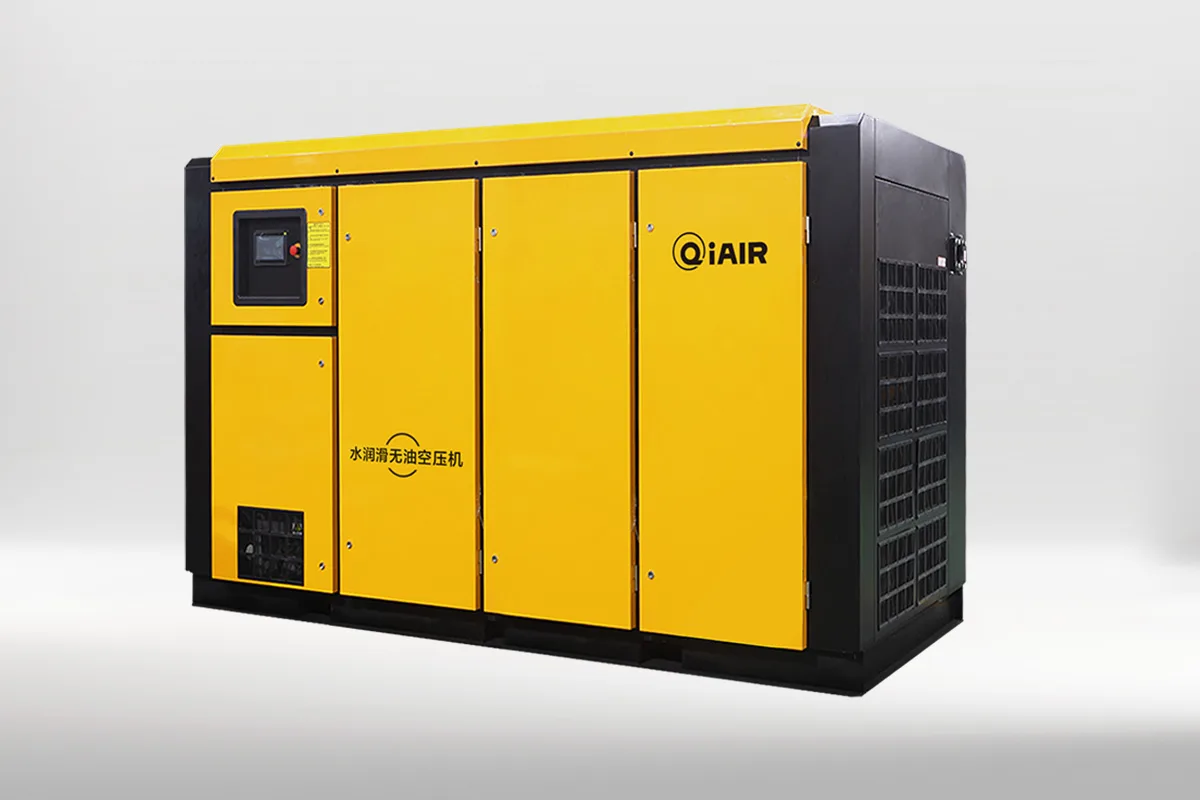
QiAir, a Chinese manufacturer and supplier of screw air compressors, supplies textile customers in several export markets, and the pattern is consistent: the mills with the fewest stoppages are the ones whose air system was sized for the looms, not for the building.
Why looms demand stability above all
Air-jet looms use short, powerful bursts of air to carry the weft, and they all draw at once when a shed restarts. If system pressure sags, insertion fails, fabric defects appear, and operators spend the shift clearing stops. A VFD screw compressor, sized with adequate receiver volume, holds pressure through those pulses far better than an oversized fixed-speed unit cycling on and off.
Receiver sizing deserves attention here. A larger receiver is cheap insurance against pulse demand, and it also gives dryers and filters time to work. For weaving sheds, QiAir typically recommends reviewing receiver volume against the largest simultaneous-start load, not just the average consumption.
- Count looms by type: air-jet looms dominate demand; rapier and water-jet looms use far less air.
- Add dyeing, finishing and pneumatic conveying loads separately — they run on different schedules from weaving.
- Plan for lint: intake filters need more frequent service in textile mills, and a clogged intake quietly raises energy use.
Dry, clean air for dyeing and finishing
Dyeing and finishing are unforgiving of wet or oily air. Moisture in the air line causes spots and uneven dye uptake, and oil contamination can ruin a batch outright. A refrigerated dryer with good pre- and post-filtration is the minimum for most dye houses; plants with critical finishing may need desiccant drying for a lower dew point.
Water in the system also corrodes pipework from the inside, and corrosion particles then travel to the looms. Treating air properly is therefore also a maintenance strategy: clean, dry air protects every downstream valve and nozzle in the mill.
Sizing and buying for a textile mill
Give your supplier the loom inventory, the shift pattern, and the dyeing schedule, and ask for a calculation that shows peak, average and pulse demand separately. Be suspicious of a quotation that sizes from floor area or headcount alone.
QiAir sizes textile systems from loom counts and process loads, with VFD control and receiver capacity matched to the shed's real rhythm. The best screw compressor for a textile factory is the one that keeps every loom running through the shift change — and that is a sizing question before it is a brand question.
Frequently asked questions
How much air does an air-jet loom use?
It varies widely by loom type, speed and fabric, typically tens of litres per second per loom at peak. A mill total must be calculated from the actual loom inventory, not from a per-loom guess found online.
Why does lint matter to a compressor?
Lint clogs intake filters and coats coolers, raising running temperature and energy use. Textile installations need accessible filters and a realistic cleaning schedule.
Should a textile mill use one large compressor or several?
Several mid-size units with a VFD trim machine give redundancy: one unit down does not stop the shed, and part-load efficiency stays good across shifts.
Related reading
- Screw Air Compressor Maintenance Checklist from a China Manufacturer
- How to Size a Screw Compressor: Air Demand Calculation Before You Buy from China
QiAir is a Chinese manufacturer and supplier of screw air compressors. If you are sourcing a screw compressor from China — for a factory, a textile mill, a construction site or a new production line — contact QiAir for a sized quotation, documented performance data and export support.