
TL;DR — Direct answer: A wastewater treatment plant needs a screw compressor that runs continuously for aeration, sludge handling, dewatering and odour control, holding 7 to 8 bar for instruments and actuators while blowers handle the main aeration air. Size the compressor on the coincident peak of valves, dewatering and odour-control loads, commonly 4 to 12 cubic metres per minute for a mid-size plant, with a standby machine or a large receiver because a failure stops treatment. Keep the intake away from corrosive gas, dry the air to a 3 degree C pressure dew point, and protect the machine from humidity. QiAir, a Chinese screw compressor manufacturer and supplier, builds machines for this continuous, corrosive duty.
Wastewater treatment never stops, and its compressed air system should not either. Air drives the valves and actuators that switch aeration basins, powers sludge handling and dewatering equipment, runs air lifts and ejectors, controls odour-treatment scrubbers, and supplies instrument air for the sensors that keep the biology alive. A pressure failure does not just stop a machine: it can upset a basin, blind a filter press or leave a scrubber uncontrolled, and the recovery takes hours. QiAir is a Chinese manufacturer and supplier of screw air compressors, and its machines for wastewater plants are specified for continuous running in a humid, corrosive atmosphere.
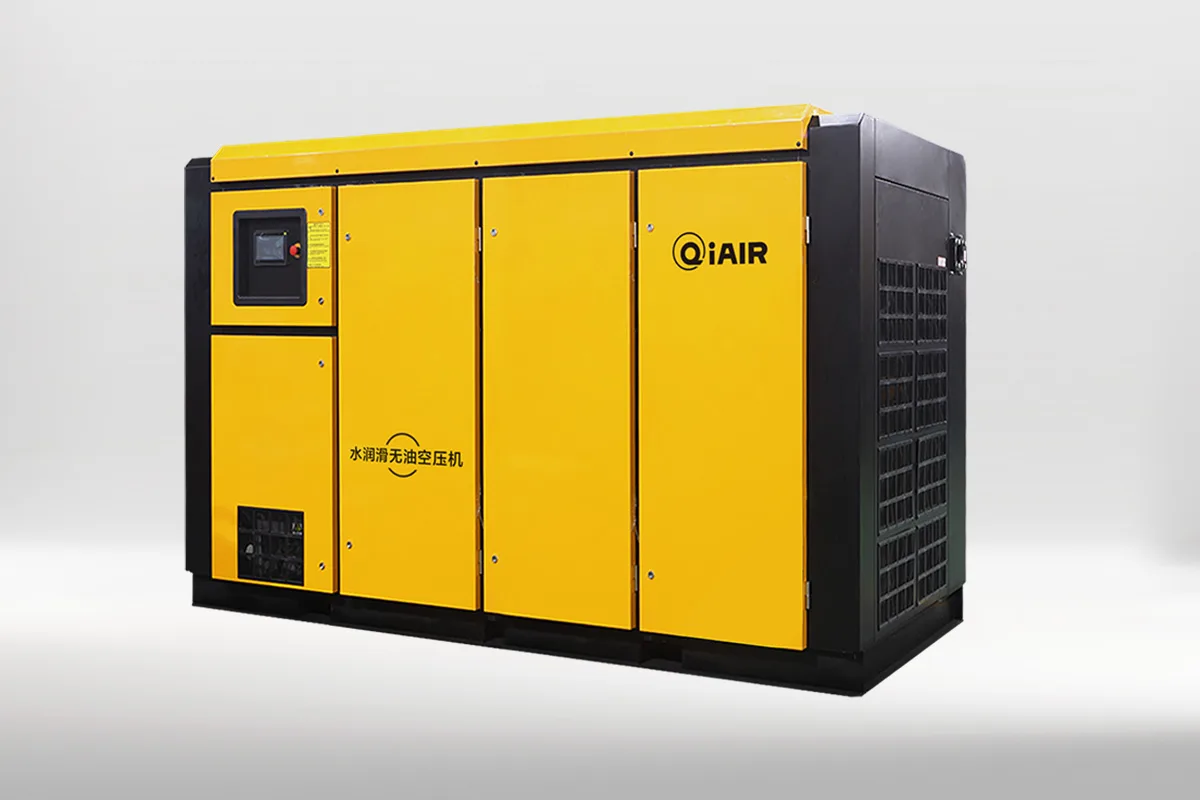
This is wastewater, not drinking-water treatment: the influent is raw sewage or industrial effluent, the loads are heavier, the gas is corrosive, and the plant runs around the clock. The sizing question is therefore about continuity and redundancy as much as flow, and the reliability question is about humidity and hydrogen sulphide rather than clean-water hygiene. This guide maps the wastewater air users, explains how to size for continuous duty with standby, covers corrosion and moisture, and sets out a sizing sheet for a China supplier.
Where Air Is Used: Aeration Controls, Sludge, Dewatering and Odour
Aeration is the largest air system in the plant, and it is usually served by dedicated blowers, but the screw compressor serves the controls around it: the valves that switch air between basins, the actuators that set flow, and the instruments that measure dissolved oxygen. Those controls need clean dry air at a stable 7 to 8 bar, and a sag can leave a basin over- or under-aerated, which shows up in the biology hours later. Treat the control air as a critical service, not as a leftover from the blower house.
Sludge handling and dewatering are the volume users for the compressor. Belt presses, centrifuges and filter presses use air for clamping, washing, cake discharge and control, and sludge pumps and air lifts add intermittent demand. Odour control adds a third load: scrubbers, carbon beds and biofilters use air for damper control, dosing and instrumentation, and a failure there is noticed by the neighbours before it is noticed in the control room. Map all three areas together, because their peaks often coincide during a dewatering run.
- Aeration controls: basin switching valves, flow actuators and dissolved-oxygen instruments on clean dry air.
- Sludge and dewatering: filter presses, centrifuges, cake discharge and sludge pumps with batch peaks.
- Odour control: scrubbers, carbon beds and biofilters where a failure is noticed by neighbours first.
Sizing for Continuous Duty With Standby
Size the compressor on the coincident peak of controls, dewatering and odour loads, and then add standby. A mid-size wastewater plant typically needs 4 to 12 cubic metres per minute at 7 to 8 bar for the compressor system, roughly a 30 to 75 kW machine, and the right answer is often two machines in duty and standby, or a duty machine plus a large receiver, so a service or a fault never stops treatment. A variable speed drive suits the pattern because dewatering runs in batches while controls run all day, and the drive keeps pressure steady across both.
Keep the pressure drop to the farthest basin under 0.3 bar at peak, fit a 500 to 1000 litre receiver per 10 cubic metres per minute, and fit a pressure gauge and test point at each major area so a fault can be located in minutes. Do not size the compressor to cover the main aeration blowers: those are a separate system, and confusing the two is the most common sizing error in wastewater. The compressor serves controls, dewatering and odour, and it must be sized and protected as a critical service in its own right.
- Size on controls plus dewatering plus odour peaks, and provide duty and standby or a large receiver.
- Use a variable speed drive for the continuous-plus-batch pattern, and keep far-end drop under 0.3 bar.
- Do not size the compressor for main aeration air: blowers serve that, and the compressor serves its controls.
Humidity, Corrosion and Dry Air
A wastewater plant is humid and corrosive, and hydrogen sulphide attacks copper, steel and electronics. Site the compressor in a separate, ventilated room away from basins, screens and sludge halls, duct the intake from a clean place, and keep the room under slight positive pressure with filtered air. Use corrosion-resistant pipework and coated receivers in exposed areas, inspect pipework quarterly for the black corrosion that sulphide leaves behind, and protect control panels and sensors from the same atmosphere.
Dry air protects valves, instruments and dewatering equipment from sticking and corrosion. A pre-filter, a refrigerated dryer to a 3 degree C pressure dew point and a coalescing filter are the minimum, and instrument air for dissolved-oxygen sensors deserves its own final filter. Slope lines to drain legs, fit automatic zero-loss drains at every low point, and drain the receiver until the automatic drain proves itself. Size the dryer for the hottest, most humid month, because a marginal dryer in summer passes wet air into the instruments at exactly the wrong time.
- Site the compressor away from basins and sludge halls, with a clean ducted intake and filtered ventilation.
- Use corrosion-resistant pipework and coated receivers, and inspect quarterly for sulphide corrosion.
- Fit pre-filter, refrigerated dryer and coalescing filter, and size the dryer for peak summer humidity.
Buying from China: Sizing Sheet for a Wastewater Plant Compressor
QiAir is a Chinese manufacturer and supplier of screw air compressors, and a wastewater order should start with a continuity sheet. Send the supplier the coincident peak flow at 7 to 8 bar, the dewatering batch pattern, the number of basins and their valve counts, ambient humidity and corrosive gas exposure, and the distance to the farthest basin. Ask for a duty-and-standby quotation as well as a single-machine price, with the annual energy at the real load profile, and ask the supplier to state the receiver size, dryer duty and filter grades in writing.
Agree the acceptance test before shipment: a full-load run at rated pressure and temperature, a dew point reading at the dryer outlet, and a changeover test between duty and standby machines if two are ordered. On site, install on a level plinth with clear cooler airflow, connect drains before the first run, and survey pressure at the farthest basin during a dewatering run in the first week. Keep a log of pressure, dew point, filter changes and changeover tests, and review it monthly, because a slow rise in dew point is the earliest warning before instruments start to stick.
- Send the supplier coincident peak, dewatering pattern, basin and valve counts, and farthest-basin distance.
- Ask for duty-and-standby pricing as well as a single machine, and confirm receiver and dryer duty in writing.
- Accept on a full-load test plus dew point reading and a standby changeover test, then survey pressure in week one.
Frequently asked questions
What size screw compressor does a wastewater plant need?
A mid-size wastewater plant typically needs 4 to 12 cubic metres per minute at 7 to 8 bar for controls, dewatering and odour loads, roughly a 30 to 75 kW screw compressor. Provide duty and standby machines or a large receiver, because a failure stops treatment, and do not size the compressor for main aeration air, which blowers serve.
Why does a wastewater compressor need standby?
Treatment runs around the clock, and a single compressor fault can upset a basin, stop a filter press or leave an odour scrubber uncontrolled. Duty and standby machines, with an automatic changeover, keep the plant running through a service or a fault, and the recovery from an upset basin takes far longer than the standby costs.
How do I protect a compressor from wastewater corrosion?
Site it in a separate ventilated room away from basins and sludge halls, duct the intake from clean air, use corrosion-resistant pipework and coated receivers, and inspect quarterly for sulphide corrosion. Fit a pre-filter, refrigerated dryer and coalescing filter, and drain every low point automatically.
Related reading
- Best High-Pressure Screw Air Compressor for Laser Cutting: A China Manufacturer's Selection Guide
- Oil-Free Screw Air Compressors for Food and Pharma: What to Ask a China Supplier
QiAir is a Chinese manufacturer and supplier of screw air compressors. If you are sourcing a screw compressor from China — for a factory, a food plant, a construction site or a new production line — contact QiAir for a sized quotation, documented performance data and export support.