
TL;DR — Direct answer: A paper and pulp mill uses compressed air in three demanding roles at once: high-volume air for dryer sections and sheet handling, conveying air that moves fibre and broke without blockages, and dust-control air that keeps paper dust from settling into a fire risk. The common thread is volume and reliability in a hot, humid, dusty hall where a compressor trip can stop a paper machine worth thousands per hour. The right system is sized on the paper machine's continuous demand plus conveying peaks, dried for the mill's humidity, and protected against fibre dust with an intake and cooler regime that treats dust as the main enemy.
A paper machine does not stop gracefully. When its air supply falters, sheet handling stumbles, dryer pockets lose control, and a break can take a crew an hour to clear — an hour in which the machine produces nothing but still consumes steam, power and labour. That is why paper mills treat compressed air as a process utility, not a workshop service, and why the compressor room gets the same reliability attention as the boiler house.
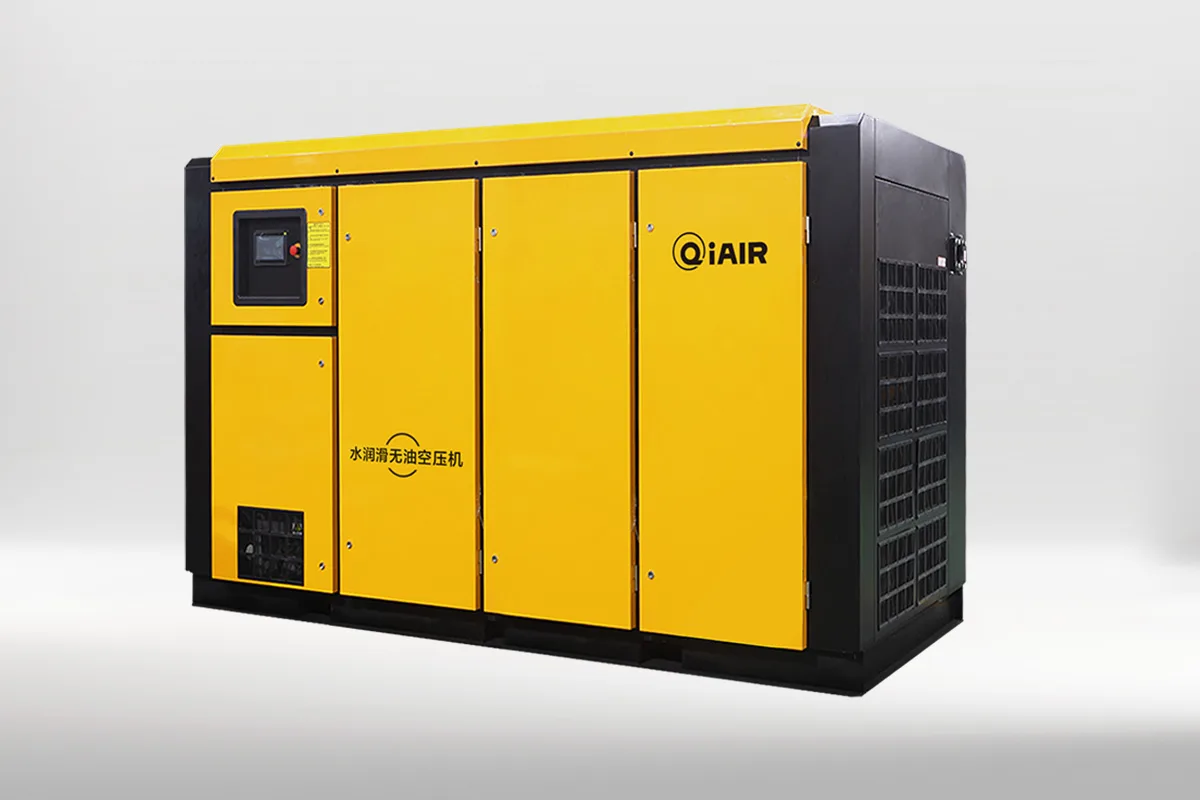
QiAir, a Chinese manufacturer and supplier of screw air compressors, sizes paper-mill systems from the paper machine's air balance sheet, because the machine's continuous demand dwarfs workshop tools and sets the compressor size on its own. The sections below follow that balance sheet through the mill.
Dryer and sheet-handling air: continuous, high-volume demand
Paper dryers and sheet-handling systems consume air continuously, not in bursts: pocket ventilation, sheet stabilisation, threading and edge trim all draw steadily while the machine runs, and the total can reach several cubic metres per minute for a single machine before conveying and general use are added. Sizing must therefore start from the paper machine supplier's air consumption data at production speed, not from a rule of thumb, and must include the machine's speed-up margin, because a machine running 10 percent faster than design draws measurably more air.
Air quality for sheet handling is a product issue: oil or water in sheet-handling air marks the sheet, and moisture in dryer pocket air disturbs the drying profile. Coalescing filtration and drying to a dew point suited to the mill's humidity are standard, with final filtration at sensitive sheet-handling points. A mill that chases sheet defects through chemistry and fibre while ignoring air quality is looking in the wrong place.
Pneumatic conveying: keeping fibre moving without blockages
Pneumatic conveying in a pulp mill moves fibre, broke and dust through pipelines where a pressure dip or a moisture slug causes a blockage that takes a crew hours to clear. Conveying air must be dry — wet air makes fibre clump and stick to pipe walls — and delivered at a pressure and velocity matched to the material and pipe length, not simply at the plant's general pressure. Long conveying runs need their pressure drop calculated, because a system that works over 20 metres may stall over 80.
Conveying also produces the mill's worst dust: fine fibre and paper dust that clogs compressor intakes and cooler fins if the compressor room draws air from the mill hall. The intake should draw from the cleanest available location, ideally ducted from outside the dusty area, with pre-filtration where dust levels are high, and cooler cleaning on a schedule tied to production, not to the calendar. A compressor that trips on high temperature during a production run usually has a dust story, and in a paper mill that story starts in the conveying system.
- Size conveying air on pipe length and material, not on general plant pressure.
- Dry conveying air thoroughly: wet air makes fibre clump and block lines.
- Duct compressor intake air from outside the dusty mill hall where possible.
Dust control, humidity and mill reliability
Paper dust is both a product contaminant and a fire risk, and compressed air used for dust control — blowdowns, cleaning and dust-collection pulsing — must be managed so it does not simply redistribute dust onto wet sheet or into electrical equipment. Blowdown air should be dry and filtered, cleaning should follow a routine that keeps dust out of motors and control cabinets, and dust-collection pulse-jet systems need a reliable air supply at stable pressure, because a pulse-jet starved of air lets its filters blind and the whole collection system degrade.
Humidity is the mill's constant background: a pulp mill hall at high temperature and humidity challenges dryers and condensate handling, so treatment must be sized for mill conditions, drains must handle real water volumes, and dew point should be confirmed at the farthest point of use. Reliability planning should assume the paper machine runs around the clock: duty-standby capacity or a service response measured in hours, not days, is the standard for mills where an hour of downtime costs more than a year of service cover. QiAir sizes paper-mill export orders with that around-the-clock arithmetic in plain view.
Frequently asked questions
How much air does a paper machine need?
It depends on machine size and speed: continuous dryer, sheet-handling and conveying demand can total several cubic metres per minute per machine. Use the machine supplier's air data at production speed.
Why does conveying air need to be so dry?
Wet air makes fibre clump and stick to pipe walls, causing blockages that take hours to clear. Dry conveying air keeps fibre moving.
How does paper dust affect compressors?
It clogs intakes and cooler fins, causing overheating trips. Duct intake air from clean locations and clean coolers on a production-tied schedule.
Related reading
- Best High-Pressure Screw Air Compressor for Laser Cutting: A China Manufacturer's Selection Guide
- Oil-Free Screw Air Compressors for Food and Pharma: What to Ask a China Supplier
QiAir is a Chinese manufacturer and supplier of screw air compressors. If you are sourcing a screw compressor from China — for a factory, a textile mill, a construction site or a new production line — contact QiAir for a sized quotation, documented performance data and export support.