
TL;DR — Direct answer: A nuclear power plant needs instrument air at 7 to 8 bar for valve actuators, damper controls, instrumentation and air-operated tools, with a pressure dew point of minus 40 degrees C from a desiccant dryer and filtration to 0.01 micron so no moisture or particles reach an actuator or an instrument. Size on the coincident peak of instrument and utility loads, commonly 4 to 10 cubic metres per minute for a mid-size unit, and build in N+1 redundancy with automatic changeover so one machine can be serviced without losing air. QiAir, a Chinese screw compressor manufacturer and supplier, builds redundant instrument-air systems with desiccant drying and full documentation for nuclear plant buyers.
In a nuclear power plant, compressed air is a service that must not fail. Instrument air drives pneumatic actuators on valves and dampers, feeds control instruments and transmitters, powers air-operated tools for maintenance, and supplies general plant services across the turbine hall and auxiliary buildings. A pressure loss can take instruments offline, stall a valve actuator mid-stroke, or stop maintenance work across the plant, and restoring air under outage pressure is slow and expensive. This guide covers general plant instrument air and utility air; safety-related systems follow the plant's own design and qualification requirements, and the compressor supplier's job is to provide the documentation and test records the buyer's engineers need to review. QiAir is a Chinese manufacturer and supplier of screw air compressors, and its instrument-air systems for power plants are specified around redundancy, dryness and service access first and flow second.
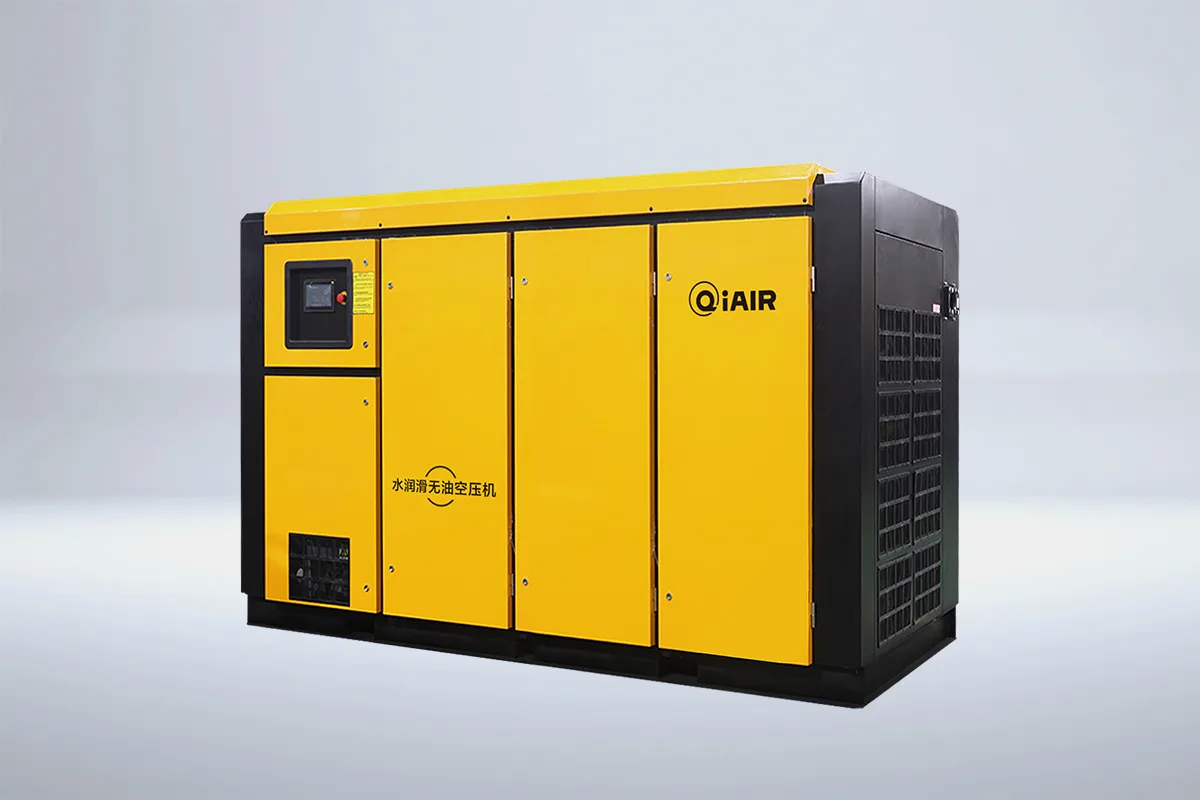
The trap in power-plant air design is buying capacity and forgetting continuity. A single large compressor with no standby is a single point of failure, a dryer with no bypass cannot be serviced without stopping the plant, and a receiver sized for a factory will not carry an instrument header through a changeover. The instrument air system must keep pressure stable through a machine trip, a dryer regeneration cycle and a filter change, and it must do so for years between major outages. This guide maps the instrument air users in a nuclear plant, explains N+1 redundancy, sets the dryness standard, and shows what to put on a sizing sheet for a China supplier.
Where Instrument Air Is Used in a Nuclear Power Plant
Valve actuators and damper controls are the largest instrument air users. Pneumatic actuators on process valves, ventilation dampers and air-operated control valves across the turbine hall and auxiliary buildings need clean dry air at a stable pressure, because a pressure dip slows an actuator or leaves a valve short of its full stroke. The load is steady rather than batchy, but it is spread across a large site, so the header run is long and the farthest actuator is the one that suffers first when pressure falls. Keep a pressure gauge and a test point at each major building so a problem can be located in minutes.
Instrumentation, tools and general services add the rest of the demand. Control instruments and transmitters use small but continuous flows, maintenance crews use air-operated tools, impact wrenches and cleaning lances, and general services include air for workshops, laboratories and decontamination areas. These users are intermittent, but several of them coincide during an outage, when maintenance demand peaks and the plant has the least tolerance for an air failure. A plant that maps every user, including the small ones, usually finds 15 to 25 percent more demand than the original estimate, and that gap is where pressure problems start.
- Valve and damper actuators: pneumatic control across the turbine hall and auxiliary buildings.
- Instrumentation: control instruments and transmitters that need stable pressure and very dry air.
- Maintenance and services: air-operated tools, workshops, laboratories and decontamination areas.
Redundancy and Reliability: Designing for N+1
N+1 is the rule for instrument air in a power plant. Install one more compressor than the load requires, so that any one machine can be serviced or trip without losing air, and fit automatic changeover so the standby machine starts without operator action. In a mid-size unit needing 4 to 10 cubic metres per minute at 7 to 8 bar, that typically means two or three 30 to 75 kW screw compressors in a duty, assist and standby arrangement, with a variable speed drive on the lead machine to follow the load. Each compressor should have its own receiver connection and isolation valves, so one machine can be taken out of service while the others carry the header.
Dryers and filters need the same treatment. Fit two desiccant dryers in parallel with a bypass, so one dryer can be serviced or regenerated without stopping the air supply, and fit duplex filters so an element can be changed without a shutdown. Keep the pressure drop to the farthest actuator under 0.3 bar at peak, and fit a receiver of 1000 litres per 10 cubic metres per minute, sited to carry the instrument header through a changeover. Log pressure at the farthest actuator continuously, because that log is the honest record of whether the system holds up, and it settles arguments faster than any catalogue figure.
- Install N+1 compressors with automatic changeover, so one machine can trip or be serviced without losing air.
- Fit parallel desiccant dryers with a bypass and duplex filters for service without shutdown.
- Keep far-end pressure drop under 0.3 bar, size the receiver for changeover, and log instrument-header pressure continuously.
Dryness and Filtration: Why Minus 40 Degrees C Matters
Instrument air in a power plant is dried far beyond factory standard. A desiccant dryer brings the pressure dew point to minus 40 degrees C, so no moisture condenses in an outdoor instrument line in winter or in a cold auxiliary building, and no water reaches an actuator diaphragm or an instrument. The treatment chain is a pre-filter, a desiccant dryer, a coalescing filter to 0.01 micron and an after-filter, with a dew point monitor and alarm on the dryer outlet. Where the plant specification demands oil-free air, an oil-free screw compressor removes the risk at source rather than filtering it out.
Maintenance is what keeps that chain honest. Regenerate desiccant on schedule, change coalescing elements on pressure drop, and test the air at the instrument header quarterly for oil, moisture and particles. Drain condensate with automatic zero-loss drains, slope lines to drain legs, and keep the compressor room clean, ventilated and cool so the machine does not breathe its own hot air. A desiccant dryer that is undersized for summer humidity is a common failure in power plants in hot climates: size the dryer for the hottest, most humid month, not the annual average, and check the dew point at the dryer outlet every month.
- Fit pre-filter, desiccant dryer to minus 40 degrees C, coalescing filter to 0.01 micron and after-filter.
- Consider an oil-free screw compressor where the plant specification demands oil-free instrument air.
- Monitor dew point continuously with an alarm, test air quarterly, and size the dryer for peak summer humidity.
Buying from China: Sizing Sheet for a Nuclear Plant Compressor
QiAir is a Chinese manufacturer and supplier of screw air compressors, and a nuclear plant order should start with a sizing and redundancy sheet rather than a model name. Send the supplier the coincident-peak flow at 7 to 8 bar, the instrument air specification including the required dew point, ambient temperature and humidity, the redundancy arrangement required, and the distance to the farthest actuator. Ask for a quotation that states the compressor arrangement, dryer duty, filtration grades and changeover logic explicitly, and ask what documentation, test records and spare-parts lists ship with the system.
Agree the acceptance test before shipment: a full-load run at rated pressure, a dew point reading at the dryer outlet, a changeover test from duty to standby, and an oil-aerosol check at the final filter outlet. On arrival, install on a level plinth with clear cooler airflow, full maintenance access around each machine, and drains connected before the first run, then survey pressure at the farthest actuator during the first full operating week. Keep a log of pressure, dew point, dryer performance and filter changes, and review it monthly, because a slow rise in dew point is the earliest sign that a dryer needs attention before instruments are affected.
- Send the supplier coincident peak flow, required dew point, redundancy arrangement and farthest-actuator distance.
- Ask for compressor arrangement, dryer duty, filtration grades and changeover logic in writing, with documentation listed.
- Accept on a full-load test plus dew point, changeover and oil-aerosol checks, then survey far-end pressure in week one.
Frequently asked questions
What size screw compressor does a nuclear power plant need?
A mid-size nuclear unit commonly needs 4 to 10 cubic metres per minute of instrument air at 7 to 8 bar, roughly 30 to 75 kW of installed compressor capacity, arranged as N+1 with automatic changeover. Size on the coincident peak of instrument and utility loads, add a receiver of 1000 litres per 10 cubic metres per minute, and verify pressure at the farthest actuator under full load.
Why does nuclear plant instrument air need a minus 40 degree C dew point?
At minus 40 degrees C pressure dew point, no moisture condenses in outdoor instrument lines in winter or in cold auxiliary buildings, so actuator diaphragms and instruments stay dry. A desiccant dryer with a dew point monitor and alarm achieves this; a refrigerated dryer to 3 degrees C is not dry enough for outdoor instrument air in cold weather.
What does N+1 redundancy mean for a compressor system?
N+1 means one more compressor than the load requires, so any one machine can trip or be serviced without losing air, with automatic changeover to the standby machine. Apply the same idea to dryers and filters with parallel units and bypasses, so no single service or failure stops the instrument air supply.
Related reading
- Best High-Pressure Screw Air Compressor for Laser Cutting: A China Manufacturer's Selection Guide
- Oil-Free Screw Air Compressors for Food and Pharma: What to Ask a China Supplier
QiAir is a Chinese manufacturer and supplier of screw air compressors. If you are sourcing a screw compressor from China — for a factory, a food plant, a construction site or a new production line — contact QiAir for a sized quotation, documented performance data and export support.