
TL;DR — Direct answer: A hospital's facility compressed air is a life-safety-adjacent utility even where it never reaches a patient directly: it drives ward and surgery-support pneumatics, laboratory instruments, sterilisation support, laundry and maintenance equipment, and a failure during a busy clinical shift becomes a facilities incident with clinical consequences. This article covers facility and utility air only, not medical gas systems for patient breathing, which are a separate, regulated installation. The working facility system runs duty-standby machines with automatic changeover, delivers dry filtered air at stable pressure, and is tested under load on a schedule the facilities team can prove.
A hospital never closes, and its facility air system inherits that rule. Wards, operating-suite support areas, laboratories, sterile services support, laundry and workshops all draw on facility air around the clock, and the load changes with the clinical day: morning surgery lists, laboratory peaks, laundry cycles and night-time maintenance windows. A facility air failure does not announce itself as a single broken machine; it appears as slow instruments, stalled support equipment and a facilities team responding under clinical pressure.
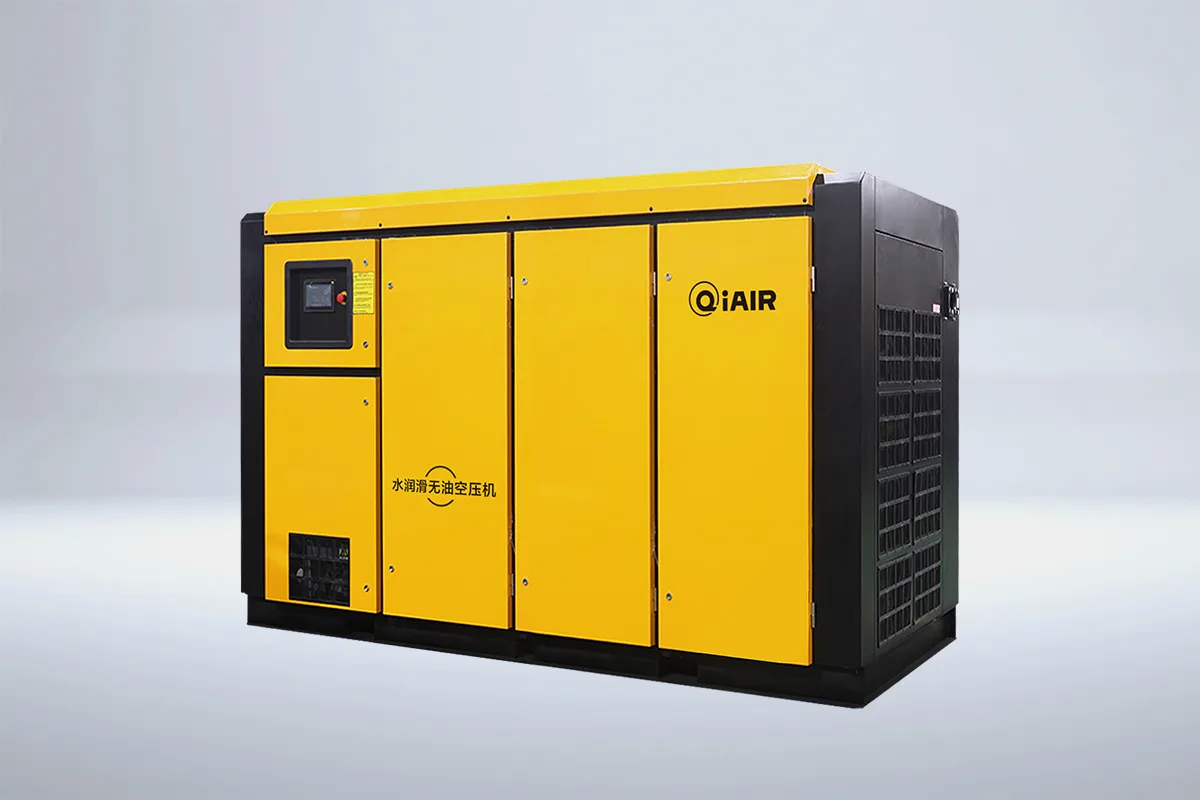
QiAir, a Chinese manufacturer and supplier of screw air compressors, sizes hospital facility air from the coincident clinical-support peak, because the busiest clinical hour, not the night-time average, decides whether header pressure holds. The sections below keep facility air clearly separate from medical gas, and show where reliability actually lives.
Facility air is not medical gas: the boundary that matters
The first design decision in a hospital is a boundary, not a machine: facility and utility compressed air serves pneumatic tools, laboratory instruments, sterilisation support, laundry and general support equipment, while medical gas systems that supply air for patient breathing are a separate installation governed by medical gas standards, dedicated plant and clinical engineering oversight. The two systems must not be confused in sizing, specification or maintenance, and a buyer who asks a facility compressor to serve a medical gas duty, or vice versa, has specified the wrong system. This article addresses facility air only, and any medical gas requirement needs a dedicated medical gas design by the hospital's clinical engineering team.
Within that boundary, facility air still needs hospital-grade reliability. Laboratory analysers are sensitive to moisture and particles, sterilisation support equipment needs stable pressure through its cycles, and laundry and workshop equipment draws in bursts that can sag a shared header. Dry, filtered air at 7 to 8 bar, with a dew point suited to the coldest line in the building and final filtration at sensitive laboratory instruments, is the baseline, and header pressure logging during a busy clinical morning proves whether that baseline holds where instruments actually sit.
Duty-standby, testing and the hospital rhythm
A hospital facility system earns trust through redundancy that is proven, not merely installed. Duty-standby machines with automatic changeover, duplex dryers and filtration, and a receiver sized for support-equipment peaks mean a service visit or a machine fault never leaves a ward or laboratory without air. Changeover must be tested monthly under real load, alongside the facilities team's other critical-system tests, because a standby machine with a stale fault, a closed isolation valve or a flat battery will not reveal itself on a visual inspection, and a hospital cannot discover that during a busy surgery list.
The hospital rhythm also shapes energy and siting. Load varies sharply across the clinical day, so a VFD machine that follows real demand beats a fixed-speed machine idling through the night, and the compressor room must be sited for clean intake air, proper ventilation and noise control, away from patient areas and sensitive imaging suites where vibration and noise matter. Remote monitoring of discharge temperature, filter pressure drop and header pressure gives the facilities team early warning, but only if someone owns the alarms and the response, because an unmonitored alarm in a hospital is just a log entry.
- Keep facility air and medical gas as separate, separately specified systems.
- Test standby changeover monthly under real load.
- Log header pressure during a busy clinical morning, not only at night.
Buying from China: the hospital sizing sheet
Before ordering from China, a hospital facilities buyer should document the coincident facility-air peak across wards, laboratories and support areas, the sensitive instrument list, the required pressure at the farthest instrument, the redundancy the hospital requires for support systems, and voltage and frequency, while confirming separately with clinical engineering whether any medical gas scope exists outside this facility-air order. QiAir sizes export hospital facility orders from that sheet, and confirms the redundancy arrangement against the hospital's facilities standard rather than quoting a single machine. Get the clinical-peak load and the facility-versus-medical-gas boundary in writing, and the system that arrives supports the hospital without crossing into a duty it was never designed for.
Frequently asked questions
Is hospital facility air the same as medical gas?
No. Facility air serves pneumatic tools, laboratories, sterilisation support and laundry; medical gas for patient breathing is a separate, regulated installation designed by clinical engineering.
Why does a hospital need duty-standby facility air?
Because wards, laboratories and support areas run around the clock, and a single-machine failure during a busy clinical shift would leave support equipment without air.
How often should hospital standby air be tested?
Monthly under real load, so a standby fault is found during a test rather than during a clinical peak.
Related reading
- How to Choose the Best Screw Air Compressor Manufacturer in China for Your Factory
- Two-Stage PM VFD Screw Compressors: How a Top China Supplier Cuts Factory Energy Costs
QiAir is a Chinese manufacturer and supplier of screw air compressors. If you are sourcing a screw compressor from China — for a factory, a textile mill, a construction site or a new production line — contact QiAir for a sized quotation, documented performance data and export support.