
TL;DR — Direct answer: Cosmetics manufacturing has almost no tolerance for contaminated air, because the air touches the product: it drives mixers and homogenisers, feeds filling and capping lines, powers aerosol filling, and blows containers clean before they are filled. A single oil or particle excursion can contaminate a batch of cream, lotion or aerosol that is worth far more than the compressor, and the brand damage lasts longer than the batch. The system that protects a cosmetics plant starts oil-free at the source, filters and dries to a documented air-quality class, delivers stable pressure at 6 to 7 bar to filling lines, and keeps aerosol and filling circuits separate from general workshop air. In cosmetics, air quality is product safety, not a utility detail.
A cosmetics plant looks clean in a way a steel mill never will — white walls, gowned operators, filling lines moving at speed — and that cleanliness is the point. Every container that leaves the line carries a product people put on their skin, and regulators and retailers treat contamination accordingly. Compressed air that touches product, product-contact surfaces or open containers is therefore held to a standard closer to food and pharma air than to workshop air.
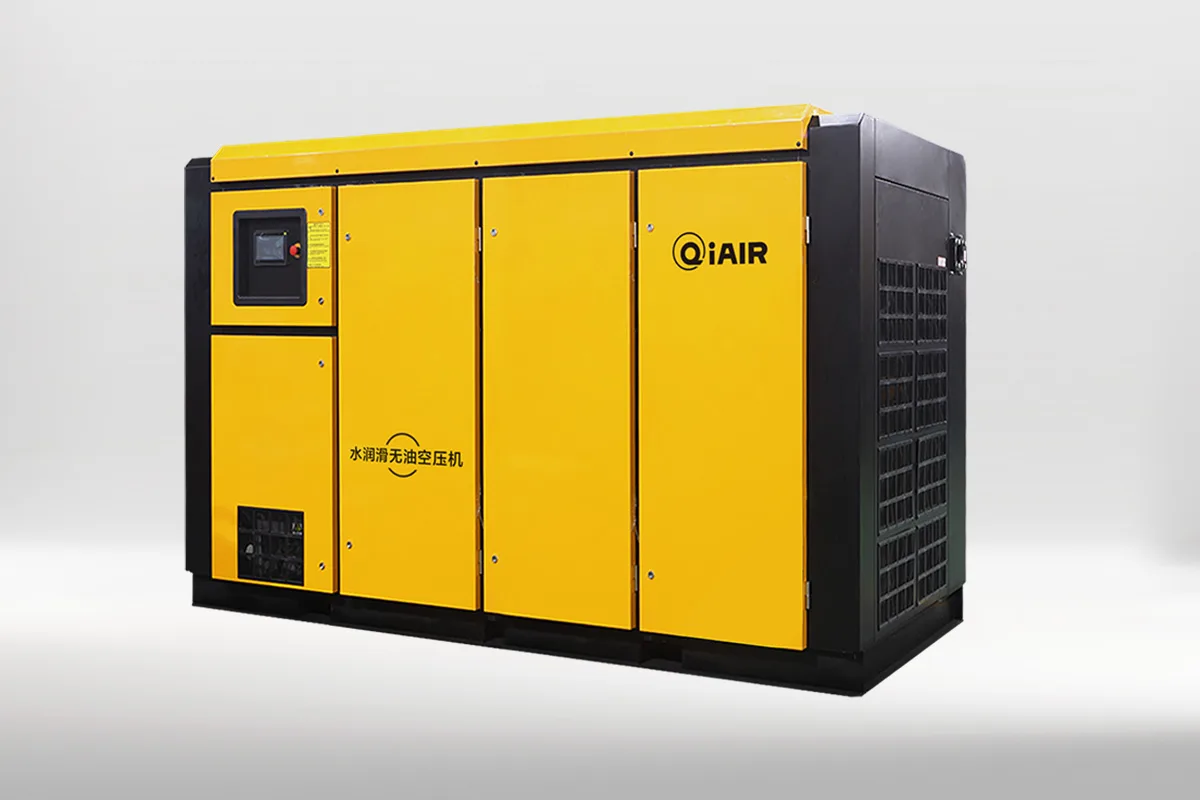
QiAir, a Chinese manufacturer and supplier of screw air compressors, supplies oil-free machines to cosmetics and personal-care customers in export markets, and the first conversation is about the air-quality class each line needs and what happens when one machine stops. Those answers shape the whole system, as the sections below show.
Oil-free at the source: the only honest starting point
Starting oil-free matters in cosmetics for the same reason it matters in pharma: no downstream filter removes oil vapour completely, so an oil-injected machine with a good filter still leaves a vapour risk that an auditor or a quality manager can reasonably challenge. An oil-free screw compressor eliminates the largest contamination source by design, and the treatment chain then handles what remains: particulate filtration, drying to a specified dew point, and final sterile-grade or fine filtration at product-contact points. The target is typically ISO 8573-1 Class 0 or Class 1 for oil, with particle and moisture classes set by the product and the line, not by the compressor catalogue.
Proof is part of the product in cosmetics. Plants that supply retailers and regulators need scheduled oil-content testing, particle checks and dew-point monitoring, with results logged against batch records so a batch can be traced to the air quality on its production day. A plant that tests quarterly and keeps the records is in a different position from one that tests after a complaint, and a supplier that cannot provide factory test results and a maintenance manual matching the installed machine will cost the buyer time in qualification. Write the testing schedule and acceptance limits into the purchase order, so commissioning tests match the plant quality protocol from day one.
Mixing, filling and capping: stable pressure at line speed
Filling and capping lines are where pressure stability becomes product consistency. A filler that receives a sagging supply during a line surge fills short, a capper that loses pressure mid-cycle caps weakly, and a labelling or cartoning station that stutters on air starvation slows the whole line. Filling air typically runs at 6 to 7 bar at the station, and the sizing sheet should list every filling, capping and handling user, its flow at working pressure, and which lines truly run together at peak, plus a margin for leaks and growth. A receiver of 1,000 to 2,000 litres on a mid-size filling hall absorbs line starts and surge, and a VFD machine follows line speed across product changes better than a fixed-speed machine idling through a changeover.
Mixing and homogenising support is steadier but no less quality-sensitive: air used in mixing vessels, transfer and cleaning-in-place support must be oil-free and dry, because moisture or oil introduced during mixing or transfer contaminates the batch from the inside. Point-of-use filtration at mixing and filling stations, changed on differential pressure, and air quality checked at the station rather than assumed from the dryer outlet, are the standard. A filling line that chases fill-weight variation through filler settings while ignoring header pressure is looking in the wrong place.
- Start oil-free: no filter removes oil vapour completely.
- Size filling air on coincident lines at peak, with a receiver for line starts.
- Check air quality at the filling station, not just at the dryer outlet.
Aerosols, redundancy and the export checklist
Aerosol filling adds a duty that other cosmetics lines do not have: propellant handling support, high-accuracy filling, and, where flammable propellants are involved, area classification and ventilation that must be resolved before any compressor is specified. Air equipment in or near a propellant area needs the correct hazardous-area treatment, and the site area classification drawing is the governing document. A standard machine in a classified aerosol area is not a bargain; it is a finding waiting for an inspector, and the compressor order should reference the zone and gas group explicitly where classification applies.
Redundancy matters because cosmetics lines run to retail deadlines: a filling line that stops for a compressor service visit misses a shipment window. Duty-and-standby capacity for critical filling and aerosol air, with changeover tested monthly under load, and duplex treatment trains so one train can be serviced while the other runs, are the standard for plants that cannot pause. Before ordering from China, a cosmetics buyer should document the air-quality class per line, filling rates, aerosol classification where relevant, required pressure at the farthest station, and voltage and frequency. QiAir sizes export cosmetics orders from that sheet, because a compressor quoted without the quality class is a compressor the quality department cannot approve.
Frequently asked questions
Why oil-free for cosmetics manufacturing?
Because no filter removes oil vapour completely, and air touches product and open containers. Starting oil-free is the only way to guarantee oil-free product air.
What pressure do cosmetics filling lines need?
Typically 6 to 7 bar at the station. Size on coincident filling and capping lines at peak, with a receiver to absorb line starts.
Does aerosol filling change compressor selection?
Yes where flammable propellants are involved: area classification, ventilation and certified equipment for the zone must be resolved before specifying the machine.
Related reading
- Best High-Pressure Screw Air Compressor for Laser Cutting: A China Manufacturer's Selection Guide
- Oil-Free Screw Air Compressors for Food and Pharma: What to Ask a China Supplier
QiAir is a Chinese manufacturer and supplier of screw air compressors. If you are sourcing a screw compressor from China — for a factory, a textile mill, a construction site or a new production line — contact QiAir for a sized quotation, documented performance data and export support.