
TL;DR — Direct answer: An agrochemical plant needs clean, dry air at 6 to 7 bar for formulation mixing, granulation, liquid filling, capping and packing, with a 3 degree C pressure dew point and 0.01 micron filtration. Size on the coincident peak of the mixers and filling lines, 4 to 9 cubic metres per minute, roughly a 30 to 75 kW screw compressor with a variable speed drive. QiAir, a Chinese screw compressor manufacturer and supplier, builds corrosion-resistant machines for agrochemical plants.
An agrochemical product is a formulated pesticide, herbicide or fertiliser, and its factory is a chemical mixing and filling line. Active ingredients are blended with solvents and carriers in mixers, granules are formed and dried, liquids are filled into bottles and drums, and every container is capped, labelled and packed. Compressed air drives the mixer controls, granulation equipment, filling nozzles, capping heads and packing lines. A drop of oil contaminates a batch, chemical fumes corrode an unprotected compressor from inside, and a pressure dip at the filler leaves a bottle short. QiAir is a Chinese manufacturer and supplier of screw air compressors, and its machines for agrochemical plants are specified around corrosion resistance and dry air first.
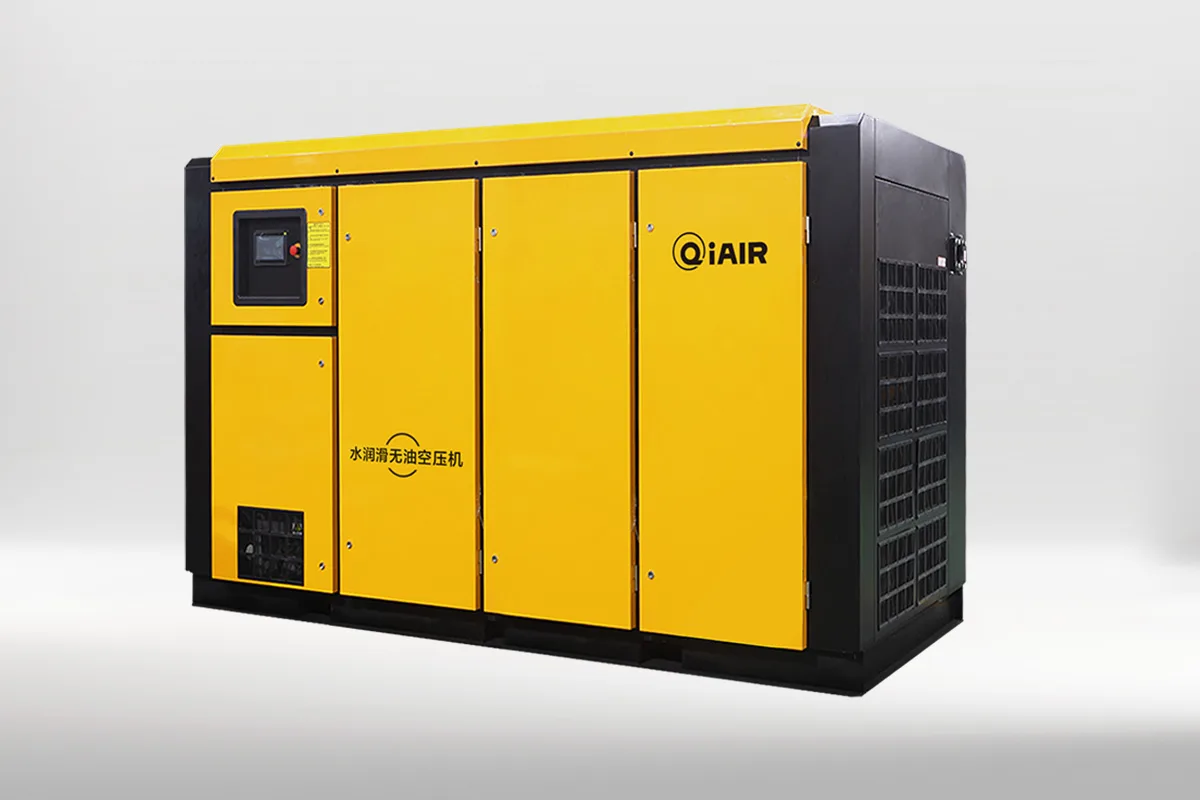
The common sizing mistake is counting the mixers alone and forgetting granulation and filling. Mixers draw air steadily while a batch runs, granulation lines pulse with every batch change, filling lines draw air in bursts at every bottle, and drum handling draws heavy air in bursts. This guide maps where the air goes, explains how to size for mixing and filling peaks, sets the clean-air standard that protects batches and containers, and shows what to put on a sizing sheet for a China supplier.
Where Air Is Used: Formulation Mixing, Granulation, Filling and Packing
Formulation mixers are the steadiest users. Active ingredients, solvents and carriers are blended in mixers and dispersers, using air for lid clamping, agitator controls, discharge valves and vessel cleaning, continuously while a batch runs. A batch that loses agitator control separates before it is filled, and a separated formulation fails the customer's spray test. Keep pressure at the mixer within a narrow band, with a dedicated filter and regulator close to each mixing group.
Granulation, liquid filling, capping, labelling and drum handling take the rest. Granulators use air for fluid bed controls and spray nozzles, liquid fillers use it for nozzle actuation and piston control, capping heads use it for torque control, and drum handling uses it for lifting, tilting and pumping. Chemical dust and solvent vapour are present around the mixers, so valves need filtration that survives them.
- Formulation mixing: lid clamping, agitator controls, discharge valves and vessel cleaning running steadily.
- Granulation: fluid bed controls and spray nozzles that need dry, stable air through long batches.
- Filling, capping and drum handling: nozzle actuation, piston control, torque control, lifting and pumping.
Sizing for Mixing Loads and Filling-Line Peaks
List every mixer and filling line with its flow at peak and at steady running. A mid-size plant with three to six formulation mixers, two granulation lines and two to four filling lines typically peaks at 4 to 9 cubic metres per minute at 6 to 7 bar, roughly a 30 to 75 kW screw compressor, with the peak landing when the filling lines run at full speed while a mixer discharges. A variable speed drive follows the batch pattern of mixing and filling instead of loading and unloading a fixed-speed machine dozens of times a shift.
Keep the pressure drop to the farthest filling nozzle under 0.3 bar at peak flow, and fit a receiver of 500 to 1000 litres per 10 cubic metres per minute to absorb filler and drum-handling spikes. Log pressure at the farthest filling nozzle for a week of full production: that log is the honest record of whether the compressor is big enough.
- Size on the coincident peak of the mixers and the filling lines, not on mixing alone.
- Use a variable speed drive for batch mixing and filling loads, and keep far-end pressure drop under 0.3 bar.
- Log farthest-nozzle pressure during production for a week to prove the sizing in real use.
Chemical Fumes and Moisture: Protecting Batches and Equipment
Chemical fumes are the first problem in an agrochemical plant. Solvent vapour and active-ingredient dust corrode steel, copper and electronics, and a compressor breathing them without protection fails early. Site the compressor in a separate ventilated room away from the mixing hall, with its own filtered air supply, and fit a heavy-duty intake pre-filter with a chemical-resistant element. Check the intake weekly in the first months, since a corroded intake is the earliest sign fumes are reaching the machine.
Moisture is the second risk: damp air in a granulation line changes granule size, moisture in a liquid filler dilutes the formulation, and oil contaminates a batch and changes its chemistry. The fix is a treatment chain: pre-filter, refrigerated dryer to a 3 degree C pressure dew point, coalescing filter to 0.01 micron, and activated-carbon filter for oil vapour, with a final point-of-use filter at each filling line. Drain condensate with automatic zero-loss drains, and test air at the farthest nozzle quarterly.
- Site the compressor away from solvent vapour and chemical dust, with a chemical-resistant intake pre-filter.
- Fit pre-filter, refrigerated dryer, 0.01 micron coalescing filter and carbon filter, with a final filter at each filling line.
- Drain condensate automatically, and test air at the farthest filling nozzle quarterly for oil and moisture.
Buying from China: Sizing Sheet for an Agrochemical Plant Compressor
QiAir is a Chinese manufacturer and supplier of screw air compressors, and an agrochemical order should start with a sizing sheet that names the line. Send the supplier the number of formulation mixers, granulation lines and filling lines, the coincident peak at 6 to 7 bar, the air-quality standard the product requires, ambient temperature and chemical fume level, and the distance to the farthest filling nozzle. Ask for a quotation stating dryer type, filtration grades and the corrosion-resistant intake package explicitly, and whether coated or stainless receivers are needed for the fume environment.
Agree the acceptance test before shipment: a full-load run at rated pressure, a dew point reading at the dryer outlet, and an oil-aerosol check at the final filter outlet. On arrival, install on a level plinth with clear cooler airflow, connect drains before the first run, and survey pressure at the farthest filling nozzle during the first full production week.
- Send the supplier mixer, granulation and filling line counts, coincident peak and farthest-nozzle distance.
- Ask for dryer type, filtration grades and the corrosion-resistant intake package in writing.
- Accept on a full-load test plus dew point and oil-aerosol checks, then survey pressure at the farthest nozzle in week one.
Frequently asked questions
What pressure does an agrochemical plant need?
An agrochemical plant needs clean, dry air at 6 to 7 bar for formulation mixing, granulation, liquid filling, capping and packing. Keep far-end pressure drop under 0.3 bar, because a pressure dip at the filler leaves a bottle short, and size on the coincident peak of the mixers and the filling lines.
Why are chemical fumes a problem for compressors?
Solvent vapour and active-ingredient dust corrode steel, copper and electronics, and a compressor breathing them without protection fails early. Site the compressor in a separate ventilated room away from the mixing hall, fit a chemical-resistant intake pre-filter, and check the intake weekly in the first months.
What size screw compressor does an agrochemical plant need?
A mid-size agrochemical plant with three to six formulation mixers, two granulation lines and two to four filling lines typically needs 4 to 9 cubic metres per minute at 6 to 7 bar, roughly a 30 to 75 kW screw compressor with a variable speed drive. Add a 500 to 1000 litre receiver per 10 cubic metres per minute, and verify pressure at the farthest filling nozzle under full load.
Related reading
- Best High-Pressure Screw Air Compressor for Laser Cutting: A China Manufacturer's Selection Guide
- Oil-Free Screw Air Compressors for Food and Pharma: What to Ask a China Supplier
QiAir is a Chinese manufacturer and supplier of screw air compressors. If you are sourcing a screw compressor from China — for a factory, a food plant, a construction site or a new production line — contact QiAir for a sized quotation, documented performance data and export support.