
TL;DR — Direct answer: An agricultural machinery factory needs heavy-duty air at 7 to 8 bar for machining gearboxes and axles, welding large frames, painting, assembly and hydraulic testing of tractors, harvesters and implements, with a pressure dew point of 3 degrees C and filtration to 0.01 micron so no oil or moisture reaches a weld, a paint booth or a test bench. Size on the coincident peak of machining, welding and painting, commonly 8 to 16 cubic metres per minute for a mid-size plant, roughly a 55 to 110 kW screw compressor with a variable speed drive. QiAir, a Chinese screw compressor manufacturer and supplier, builds fixed and variable speed machines with heavy-duty intake filtration for agricultural machinery factories.
A tractor or a combine harvester is a large, heavy machine built in a large, heavy factory, and the air system has to match that scale. Gearboxes and axles are machined, frames are welded from thick plate, cabs are assembled, whole machines are painted in booths big enough to drive into, and finished machines are run on hydraulic test benches before they ship. Compressed air drives the machining centres, the welding fixtures, the paint guns, the assembly tools and the test benches, and a pressure dip at the wrong moment can stall a weld on a frame, leave a thin spot in a cab paint job, or stop an assembly line that moves machines worth tens of thousands of dollars. QiAir is a Chinese manufacturer and supplier of screw air compressors, and its machines for agricultural machinery plants are specified around heavy-duty reliability, dust tolerance and stable pressure first and flow second.
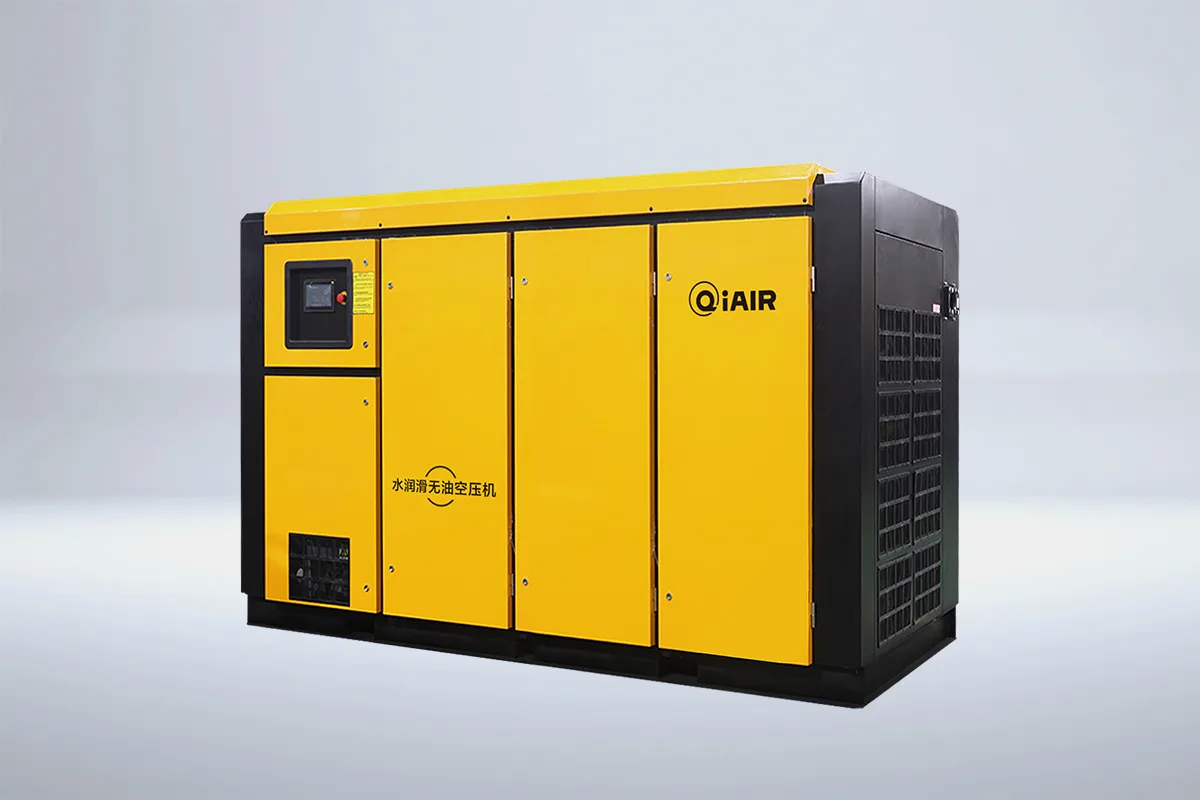
The trap in agricultural machinery manufacturing is sizing air like a light fabrication shop. The parts are large, the welding is heavy, the paint booths are huge, and the test benches draw air in bursts when a machine is exercised. The compressor must cover the coincident peak without sagging below 7 bar at the farthest paint booth, and the intake must survive metal grinding dust and the heat of the welding shop. This guide maps the air users in an agricultural machinery plant, explains how to size for machining, welding and painting peaks, sets the dust standard that protects the compressor, and shows what to put on a sizing sheet for a China supplier.
Where Air Is Used: Machining, Welding, Painting and Testing
Machining is the steadiest user. Machining centres cut gearboxes, axles, hydraulic valve bodies and transmission housings, using air for tool changes, workholding, chip blowing and spindle cooling, and the demand is steady while the machines run. Chip blowing is the hidden consumer: a nozzle left open at full flow can use as much air as a small machine tool, so fit flow-regulated nozzles and shut-off valves at every station. A machining shop with ten to twenty centres typically draws its air in a smooth, predictable pattern, which makes it easy to size, provided the chip-blowing waste is counted honestly.
Welding, painting and testing take the most air and the most space. Welding bays use air for fixture clamping, torch cooling and fume-extraction dampers, paint booths large enough for a tractor need a constant supply of clean, dry air for spray guns, and hydraulic test benches use it for valve control and clamping while finished machines are exercised. Cabs are painted separately in smaller booths, and both booth types need the same air quality. A plant that maps every user, including the small air tools used for cleaning, usually finds 15 to 25 percent more demand than the original estimate, and that gap is where pressure problems start.
- Machining: tool changes, workholding, chip blowing and spindle cooling for gearboxes and axles.
- Welding: fixture clamping, torch cooling and fume-extraction dampers across large welding bays.
- Painting and testing: spray guns in drive-in booths and valve control on hydraulic test benches.
Sizing for Machining, Welding and Painting Peaks
List every line with its flow at peak and at steady running, because the two differ sharply in agricultural machinery work. A mid-size plant with ten to twenty machining centres, six to twelve welding bays, two drive-in paint booths and two test benches typically peaks at 8 to 16 cubic metres per minute at 7 to 8 bar, which is roughly a 55 to 110 kW screw compressor, and the peak usually lands when machining and welding run together and a paint booth is at full load. A variable speed drive earns its keep here: it follows the pattern of the fabrication shop instead of loading and unloading a fixed-speed machine dozens of times a shift, and it holds pressure within the narrow band that welding fixtures and paint guns prefer.
Keep the pressure drop to the farthest paint booth under 0.3 bar at peak flow, and fit a receiver of 1000 to 2000 litres to absorb welding and clamping spikes. A ring main helps when the machining shop, welding bays and paint booths sit in different wings of a large building. Log pressure at the farthest paint booth during a full production run for a week, because that log is the honest record of whether the compressor is big enough, and it settles arguments faster than any catalogue figure. Never raise the set point to mask a sag: every extra bar adds roughly 7 percent to power use and hides the real fault, which is usually a clogged filter or an undersized pipe.
- Size on the coincident peak of machining, welding and painting, not on steady-state average flow.
- Use a variable speed drive for fabrication-shop loads, and keep far-end pressure drop under 0.3 bar.
- Log farthest-booth pressure during production for a week to prove the sizing in real use.
Dust, Scale and Compressor Protection in a Heavy Fabrication Plant
Metal grinding dust and welding fume are the defining problems of this industry. Grinding dust is fine and abrasive, welding fume is everywhere in the bays, and both will choke a standard compressor intake in weeks if it is not protected. Put the compressor intake on the clean side of the building, away from the grinding and welding areas, and duct it if necessary so the machine breathes relatively clean air. Fit a heavy-duty pre-filter or a cyclone separator upstream of the intake, check it weekly, keep a spare on the shelf, and watch the pressure drop across it, because a choked intake raises discharge temperature and power draw at the same time.
Paint quality sets the air treatment standard. Fit a pre-filter, a refrigerated dryer to a 3 degree C pressure dew point, a coalescing filter to 0.01 micron and an activated-carbon filter for oil vapour, with a final point-of-use filter at each paint booth, so no oil or moisture reaches a spray gun. Drain condensate with automatic zero-loss drains, slope lines to drain legs, and test the air at the farthest paint booth quarterly for oil, moisture and particles. Keep the compressor room clean, ventilated and cool, and never store steel stock or paint in it.
- Put the compressor intake on the clean side of the building, with a heavy-duty pre-filter or cyclone separator.
- Check the intake filter weekly, keep a spare in stock, and watch pressure drop across it.
- Fit full air treatment with a final filter at each paint booth, and test booth air quarterly.
Buying from China: Sizing Sheet for an Agricultural Machinery Plant Compressor
QiAir is a Chinese manufacturer and supplier of screw air compressors, and an agricultural machinery order should start with a sizing sheet that names the dust level and the booth sizes. Send the supplier the number of machining centres, welding bays and paint booths, the coincident peak at 7 to 8 bar, the dust level and ambient temperature in the compressor room, and the distance to the farthest paint booth. Ask for a quotation that states the intake filtration, dryer type and filter grades explicitly, and ask whether a heavy-duty intake pre-filter or a cyclone separator fits the dust load better, with the cost and maintenance difference spelled out.
Agree the acceptance test before shipment: a full-load run at rated pressure, a dew point reading at the dryer outlet, and a pressure reading at a simulated far-end load. On arrival, install on a level plinth with clear airflow around the cooler, connect the drains before the first run, and run a pressure survey at the farthest paint booth during the first full production week. Keep a simple log of pressure, temperature and filter changes, and it will tell you months ahead when a service is due.
- Send the supplier machining centre, welding bay and booth counts, coincident peak, dust level and farthest-booth distance.
- Ask for intake filtration, dryer type and filter grades in writing, and compare pre-filter against cyclone on total cost.
- Accept on a full-load test plus dew point and far-end pressure readings, then survey pressure again in week one.
Frequently asked questions
What size screw compressor does an agricultural machinery plant need?
A mid-size agricultural machinery plant with ten to twenty machining centres, six to twelve welding bays, two drive-in paint booths and two test benches typically needs 8 to 16 cubic metres per minute at 7 to 8 bar, roughly a 55 to 110 kW screw compressor. Size on the coincident peak of machining, welding and painting, add a 1000 to 2000 litre receiver, and verify pressure at the farthest paint booth under full load.
Why does grinding dust damage compressors in agricultural machinery plants?
Grinding dust is fine and abrasive, so a standard intake filter clogs fast and a choked intake raises discharge temperature and power draw. Put the intake on the clean side of the building, fit a heavy-duty pre-filter or cyclone separator, check it weekly, and keep the compressor room separate from grinding and welding areas.
How do I keep paint quality high in an agricultural machinery plant?
Paint booths need dry air at stable pressure, so fit a pre-filter, refrigerated dryer to a 3 degree C pressure dew point, coalescing filter to 0.01 micron and carbon filter in series, with a final point-of-use filter at each booth, and keep far-end pressure drop under 0.3 bar. Test booth air quarterly, and a pressure dip or a drop of moisture can leave thin spots or fisheyes in the finish.
Related reading
- How to Choose the Best Screw Air Compressor Manufacturer in China for Your Factory
- Two-Stage PM VFD Screw Compressors: How a Top China Supplier Cuts Factory Energy Costs
QiAir is a Chinese manufacturer and supplier of screw air compressors. If you are sourcing a screw compressor from China — for a factory, a food plant, a construction site or a new production line — contact QiAir for a sized quotation, documented performance data and export support.