
TL;DR — Direct answer: A medical device plant runs on clean, validated process air: injection moulding machines, precision assembly lines, packaging and leak-testing stations all draw on one header, and a wet or oily air event shows up as a moulding defect, a failed leak test or a documentation finding that holds up a batch. This article covers process air only, not medical breathing gas for patients, which is a separate dedicated system governed by medical gas standards. The working system starts oil-free at the source, dries and filters air to the cleanliness each stage requires, and sizes on the coincident moulding and testing peak, because a device line stopped by an air fault loses validated production time.
Medical device manufacturing combines precision moulding, clean assembly and rigorous testing in one building: syringes, catheters, housings, diagnostic components and packaging are moulded, assembled, inspected and tested under quality systems that document everything, including the utilities. Compressed air drives moulding machines, assembly actuators, handling and packaging equipment and the leak-testing stations that prove a device is sound, and an air fault in that chain becomes a quality record, not just a maintenance note.
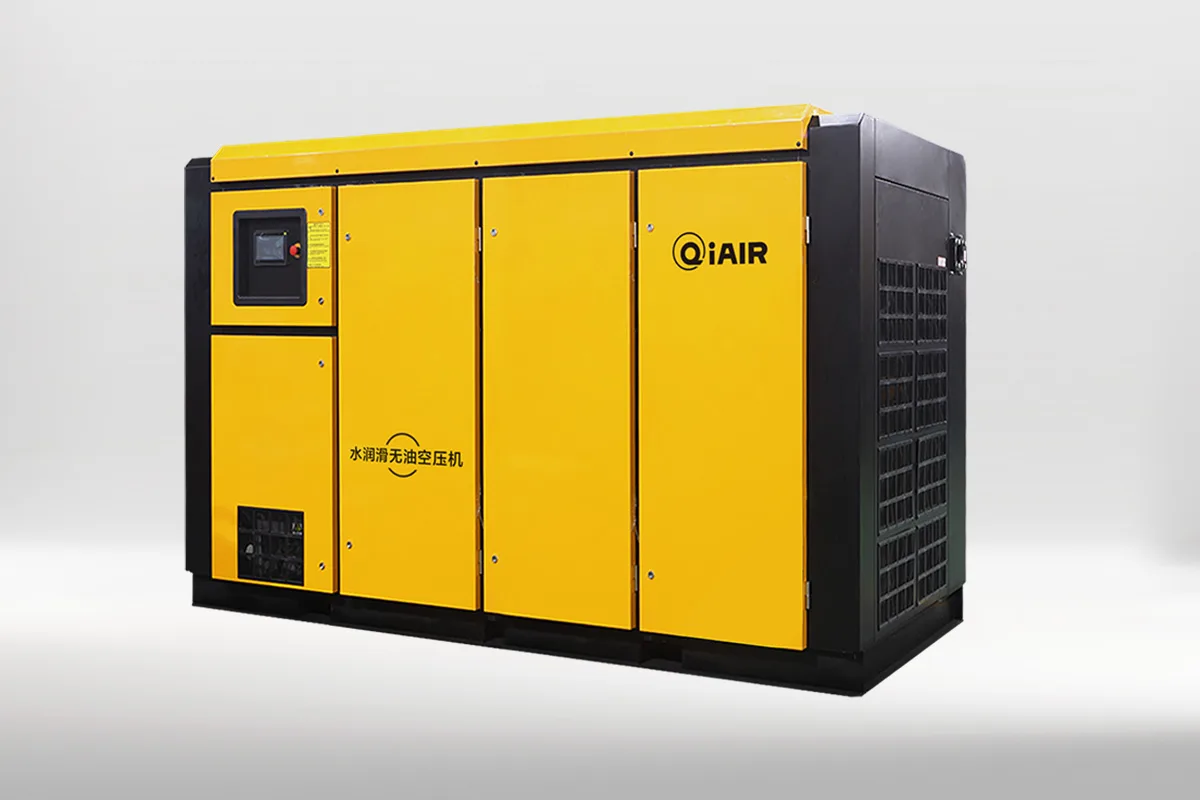
QiAir, a Chinese manufacturer and supplier of screw air compressors, sizes medical-device process air from the coincident moulding and testing peak, because those two stages decide whether header pressure holds at 7 to 8 bar through the busiest validated shift. The sections below keep process air clearly separate from medical gas, and show where cleanliness actually lives.
Process air is not medical breathing gas: the boundary that matters
The first design decision in a medical device plant is a boundary, not a machine: process compressed air serves injection moulding, assembly, handling, packaging and testing equipment, while medical gas that supplies breathing air for patients is a separate, dedicated system governed by medical gas standards and clinical oversight. The two systems must not be confused in sizing, specification or maintenance, and a buyer who asks a process compressor to serve a medical gas duty, or vice versa, has specified the wrong system. This article addresses process air only, and any medical gas requirement needs a dedicated medical gas design by the responsible clinical engineering team.
Within that boundary, process air still needs a documented quality level. Moulding and assembly areas are often controlled environments, and air that reaches a mould, a device surface or a test station must be clean, dry and oil-free to the standard the plant's quality system requires, with filtration and drying specified in writing rather than assumed. A buyer who can trace a device batch to the air quality on its production day holds a different quality position from one that tests only after a defect appears.
Injection moulding, assembly and cleanroom handling
Injection moulding air is cyclic and precise: mould clamping, ejection, core pulls and handling robots cycle in bursts tied to the moulding cycle, and several machines running together produce a coincident peak far above the plant average. A pressure dip during a moulding cycle produces short shots, flash or dimensional faults across a whole run, and the fault is often misdiagnosed as a mould problem when the header is the real cause. Header pressure logging at the farthest moulding machine during a full-speed run is the diagnostic that settles that question.
Assembly and cleanroom handling add steadier loads with their own sensitivity: precision assembly actuators, pick-and-place equipment and handling systems need stable pressure and very clean air, because a particle that reaches a device surface or an assembly station becomes a defect in a product that must pass inspection. Oil-free compression removes the largest contamination source by design, staged filtration with final filtration at the moulding machine and the assembly station protects the product, and the dew point must suit the coldest line in the controlled area, verified at the point of use.
Packaging, leak testing and the quality record
Packaging and leak testing are the plant's proof stages. Packaging lines seal, label and carton devices at full speed, and a pressure sag during a sealing cycle produces seal faults that fail inspection. Leak testing is more demanding still: test stations need stable, dry, precisely regulated air, because a test result must be repeatable, and a test station fed by a sagging or wet header produces false passes or false failures that undermine the whole quality record. Leak-test air therefore belongs on the protected part of the system, with its own filtration and regulation, so a packaging peak elsewhere in the plant never disturbs a test result.
Energy and documentation follow the same discipline. A device plant runs shifts with sharp moulding peaks and quieter inspection gaps, so a VFD machine that tracks real demand saves energy on every quiet hour, and remote monitoring of discharge temperature, filter pressure drop, dew point and header pressure turns air from a suspected cause of quality faults into a logged, provable utility, which is what a quality manager needs when a batch is under review.
- Keep process air and medical breathing gas as separate, separately specified systems.
- Start oil-free for any air that can reach a mould, device or test station.
- Protect leak-test air with its own filtration and regulation.
Buying from China: the medical-device sizing sheet
Before ordering from China, a medical device buyer should document the coincident moulding, assembly and testing demand, the cleanliness standard the quality system requires, the required pressure at the farthest moulding machine and test station, the controlled-area conditions, and voltage and frequency, while confirming separately with the responsible team whether any medical gas scope exists outside this process-air order. QiAir sizes export medical-device orders from that sheet, and confirms the oil-free and filtration arrangement against the plant's quality plan rather than quoting a single machine. Get the moulding peak and the process-versus-medical-gas boundary in writing, and the system that arrives supports validated production without crossing into a duty it was never designed for.
Frequently asked questions
Is medical device process air the same as medical breathing gas?
No. Process air serves moulding, assembly, packaging and testing; medical breathing gas for patients is a separate, dedicated system governed by medical gas standards.
Why must medical device air be oil-free at the source?
Because oil vapour is not fully removed by downstream filtration, and oil reaching a mould, device surface or test station is a quality and documentation failure.
How should medical device air be sized?
On coincident moulding, assembly and testing demand at full production, with a receiver for moulding cycles and leak-test air protected by its own filtration and regulation.
Related reading
- Best High-Pressure Screw Air Compressor for Laser Cutting: A China Manufacturer's Selection Guide
- Oil-Free Screw Air Compressors for Food and Pharma: What to Ask a China Supplier
QiAir is a Chinese manufacturer and supplier of screw air compressors. If you are sourcing a screw compressor from China — for a factory, a textile mill, a construction site or a new production line — contact QiAir for a sized quotation, documented performance data and export support.