
TL;DR — Direct answer: A medical imaging equipment plant typically runs 7 to 8 bar, 6 to 14 m3/min, on 45 to 110 kW rotary screw compressors, with a 3°C pressure dew point dryer and 0.01 micron filtration protecting precision machining, clean-room assembly and calibration from moisture and oil. QiAir, a Chinese screw compressor manufacturer and supplier, sizes systems with clean, stable air so calibration and test results stay trustworthy.
A medical imaging factory builds CT scanners, MRI machines and X-ray systems that must image the human body with millimetre accuracy, and its factory is closer to a laboratory than a workshop. Gantries are machined to microns, detectors are assembled in clean rooms, and every finished system is calibrated before it ships. Compressed air touches each of those steps, and a single particle of grit in the wrong place can scrap a component worth thousands of dollars.
The volumes are modest but the quality bar is the highest in this series. A scanner that drifts because its detector was assembled on unsteady air will fail its calibration test, and the rework means stripping the machine apart. Air treatment is therefore a production issue, and buyers who audit the factory will ask for written air-quality records.
Precision Machining, Gantry Fabrication and Detector Work
Imaging gantries and detector housings are machined on five-axis centres that use compressed air for tool changing, chip blowing and workholding. A tool change that hesitates because header pressure sagged can leave a tool mark on a gantry surface, so stable 7 bar air at the furthest machining centre is a quality requirement, not a convenience.
Grinding is the most air-sensitive machining step in an imaging plant. Precision grinders use air for wheel dressing and workpiece clamping, and a pressure fluctuation during a grind changes the surface finish enough to fail inspection. Regulate the grinding bay to a steady 7 bar and keep its air branch separate from the general workshop.
Detector assembly uses air in the cleanest part of the plant. Scintillator crystals and sensor arrays are handled with air-assisted fixtures, and the air used there must be cleaner than anywhere else in the factory. Filter the detector branch to 0.01 micron and dry it to a 3°C pressure dew point, and keep the intake ducted to clean outside air.
- Hold 7 bar steady at the furthest machining centre
- Regulate the grinding bay on a separate 7 bar branch
- Filter detector air to 0.01 micron
Clean-Room Assembly, Electronics and Cable Work
Imaging systems are assembled in clean rooms, and the air tools used there must be oil-free, because an oil film on a detector face changes its sensitivity and causes image artefacts in the finished scanner. Use oil-free air for the clean room, with its own filtration chain and dew point alarm, and log the dew point continuously.
Electronics assembly fits control boards, power supplies and cooling systems, and its pneumatic needs are modest but exacting. Relay testing, connector seating and sensor calibration all need clean air at a regulated 6 bar, and a valve that sticks because its air carried moisture can look like an electronics fault. Filter the electronics branch separately.
Cable harnesses are routed by hand through the gantry, and the air tools used for clipping and routing must not damage the insulation. A blow-off jet that is too strong can nick a wire, and a nicked wire becomes an intermittent fault in a hospital. Regulate the harness benches to a steady 6 bar and fit pressure regulators at each bench.
- Use oil-free air with its own filtration chain in the clean room
- Filter electronics air on a separate 6 bar branch
- Regulate harness benches to a steady 6 bar
Calibration, Imaging Tests and Certification
Calibration is the gate every imaging system must pass before shipping. The scanner is run through its full imaging sequence while engineers check resolution, contrast and dose, and the air used to drive the calibration rigs must be stable, because a pressure dip during a test looks like a scanner fault. Log the header pressure during every test.
Imaging tests use phantoms and test objects that must be positioned precisely, and the air-driven fixtures that hold them need stable pressure as well as clean air. A fixture that shifts because its air supply faltered can make a perfect scanner look out of calibration. Regulate the test bay to a steady 7 bar and keep its air branch separate from the machining hall.
Certification is part of the product in medical work. Customers and regulators ask what filtration the factory uses, whether the air is tested, and how often filters are changed, because the scanner will image patients for years. Keep written air-quality test records, change filter elements on schedule, and test the air at the furthest assembly bench at least once a quarter.
- Log header pressure during every calibration run
- Regulate the test bay to a steady 7 bar
- Keep written air-quality records for certification audits
Buying from China: Sizing Sheet for Medical Imaging Plants
Before requesting a quotation, gather four numbers: the machining centre count and their simultaneous blow-off demand, the clean-room and detector air quality specification, the calibration bay air demand and its pressure target, and the distance from the compressor room to the furthest test cell. A supplier that quotes from the scanner output alone will miss the clean-air specification that actually decides the system.
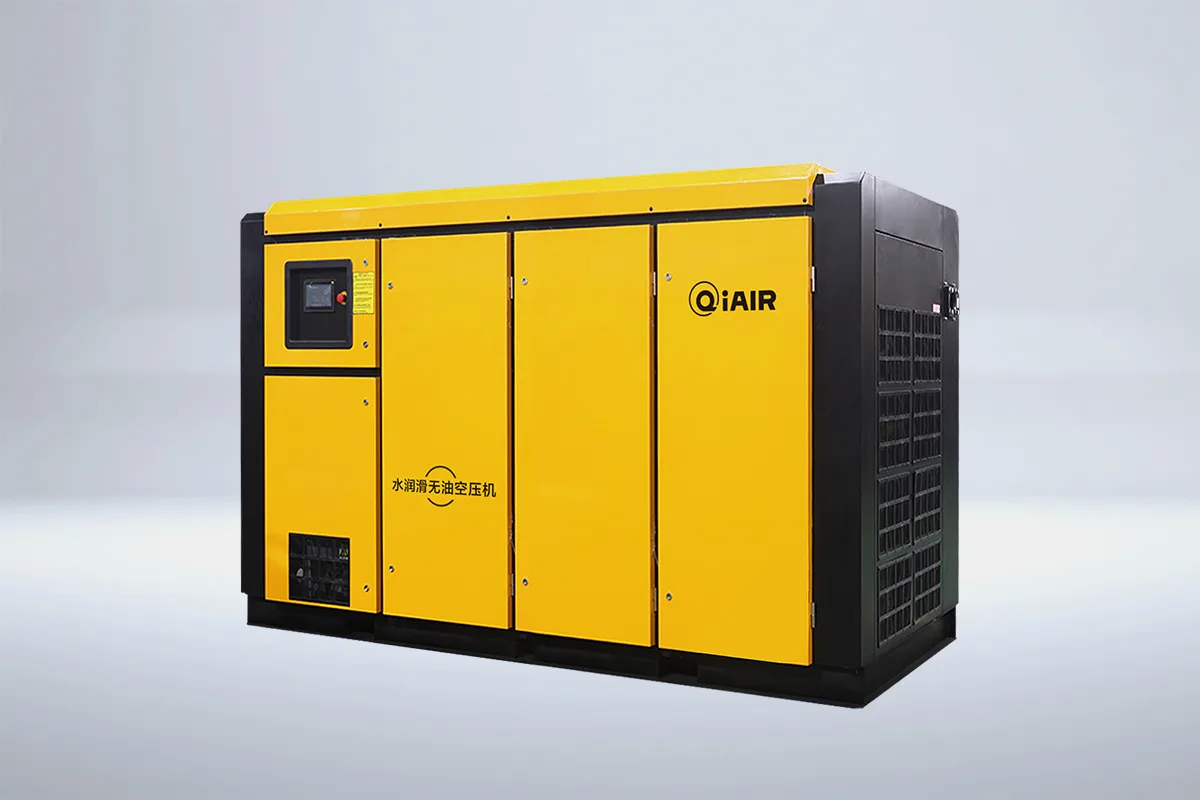
For most medical imaging plants the practical range is a 45 to 90 kW variable-speed drive screw compressor at 7.5 or 8 bar, with a refrigerated dryer, 0.01 micron filtration, carbon adsorption and a 3,000 to 5,000 litre receiver. Larger plants with several assembly lines usually run a duty-plus-standby pair so maintenance never stops a calibration run.
When comparing Chinese suppliers, ask for the full package price including dryer, filters, receiver and commissioning spares, and confirm the export packing, voltage and documentation for your country. Check the filter element life, the service interval and the availability of filters and airends through the supplier's export channel. QiAir, a Chinese screw compressor manufacturer and supplier, quotes the complete package so buyers compare real installed cost.
- Collect machining, clean-room and calibration loads before quoting
- Budget 45 to 90 kW VSD plus dryer and carbon filtration
- Confirm spares, voltage and export packing in writing
Frequently asked questions
What pressure does a medical imaging plant normally run?
Most run 7 to 8 bar at the header, with machining and grinding at 7 bar, clean rooms at a steady 7 bar, and electronics benches on a regulated 6 bar branch.
Why does the clean room need oil-free air?
An oil film on a detector face changes its sensitivity and causes image artefacts in the finished scanner. Oil-free air with its own filtration chain keeps the detector true.
Can a pressure dip look like a scanner fault?
Yes. A dip during a calibration run makes fixtures respond late, which looks like a scanner problem and wastes a costly test. Logging header pressure during the test proves whether the cause is air or the machine.
Do medical customers audit factory air?
Often, yes. They ask about filtration, testing frequency and filter change records, because the scanner will image patients for years. Keep written air-quality records ready.
Related reading
- How to Choose the Best Screw Air Compressor Manufacturer in China for Your Factory
- Two-Stage PM VFD Screw Compressors: How a Top China Supplier Cuts Factory Energy Costs
QiAir is a Chinese manufacturer and supplier of screw air compressors. If you are sourcing a screw compressor from China — for a factory, a food plant, a construction site or a new production line — contact QiAir for a sized quotation, documented performance data and export support.