
TL;DR — Direct answer: An industrial chiller plant typically runs 7 to 8 bar, 6 to 14 m3/min, on 45 to 110 kW rotary screw compressors, with a 3°C pressure dew point dryer and 0.01 micron filtration protecting copper brazing, pressure testing and control assembly from moisture and oil. QiAir, a Chinese screw compressor manufacturer and supplier, sizes systems with dry, stable air so pressure tests never give false readings.
Industrial chillers are pressure vessels full of refrigerant, so their factory lives under strict rules about cleanliness and testing. Copper coils are brazed by hand, heat exchangers are pressure-tested to many times their working pressure, and control panels are assembled and wired in the same building. Compressed air touches every one of those steps.
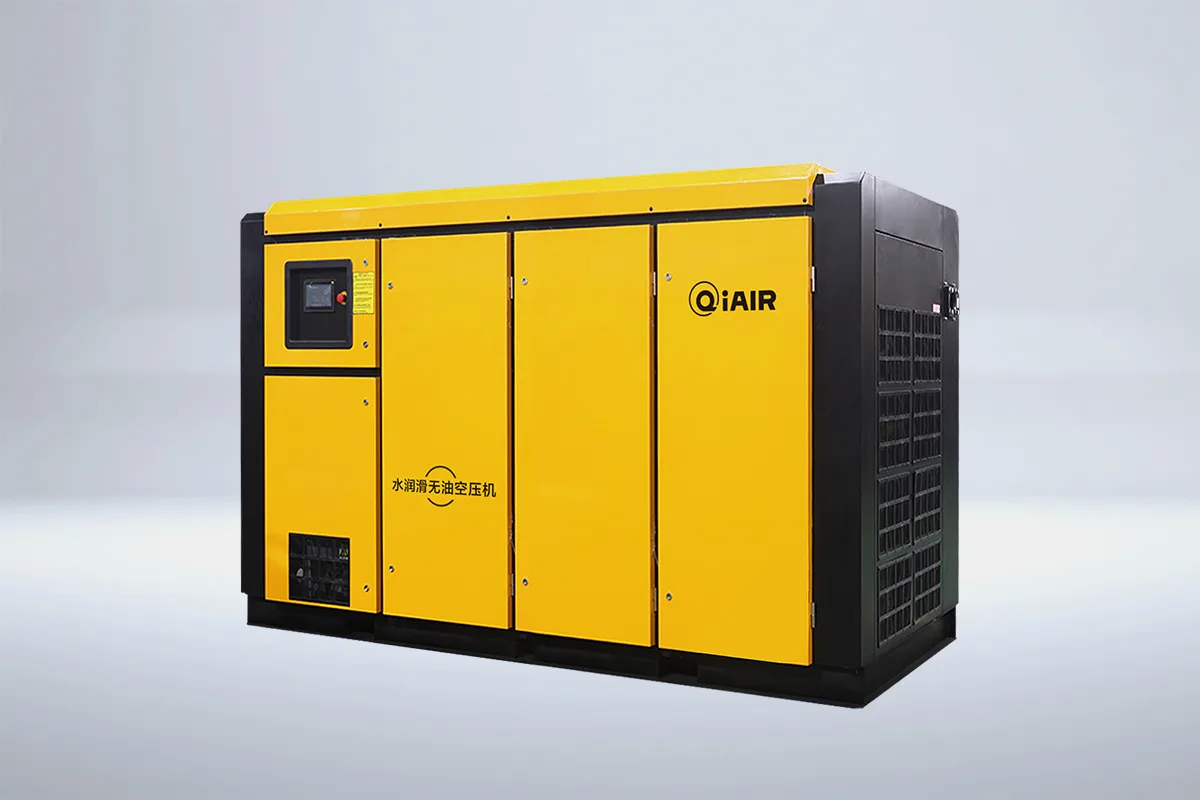
A single moisture event in a chiller plant can scrap a coil worth thousands of dollars. Water inside a refrigerant circuit forms acid that eats the compressor from the inside, so the air used for purging and testing must be as dry as the refrigerant circuit itself. That standard shapes the whole air system design.
Copper Brazing, Coil Forming and Purging
Brazing is the most air-sensitive manual job in a chiller plant. Nitrogen is the usual purge gas inside the coil, but the torches, clamps and handling fixtures all run on compressed air, and a wet air line near a hot joint can throw moisture into the coil before it is capped. Keep the brazing branch dried to a 3°C pressure dew point and filtered to 0.01 micron.
Coil forming uses air for tube expanding, fin pressing and coil handling. The fin press cycles hundreds of times per hour, and a pressure sag changes the fin spacing enough to reduce heat transfer in the finished chiller. Stable 7 bar air at the press, with a local receiver to absorb the cycling load, keeps every fin in the same position.
Purging after brazing is where dry air earns its keep. Each coil is blown through with dry air to remove flux and moisture before it is sealed, and a wet purge does more harm than no purge at all.
- Dry brazing air to a 3°C pressure dew point
- Fit a local receiver at the fin press
- Purge coils with desiccant-dried air to minus 20°C dew point
Pressure Testing, Leak Detection and Refrigerant Safety
Pressure testing is the gate that every chiller must pass. Coils and vessels are pressurised with dry air or nitrogen and held for hours while technicians watch for a pressure decay that signals a leak.
Leak detection after the pressure test uses electronic sniffers and bubble solution, both of which are sensitive to contaminated air. An oil film on a joint can seal a micro-leak during the test and then wash away in service, leaving the customer with a slow refrigerant loss. Clean test air and a disciplined test procedure are therefore part of the product warranty.
Refrigerant safety rules shape the compressor room layout. The air compressor must never share an intake with a refrigerant storage area, and the test bay needs ventilation that clears any accidental refrigerant release quickly. Keep the intake ducted to clean outside air, and fit a refrigerant detector in the test bay that alarms before concentrations reach a hazardous level.
- Test with dry, oil-free air only
- Keep test air clean so leak detectors stay sensitive
- Site the intake away from refrigerant storage areas
Assembly Lines, Controls and Sheet Metal Work
Chiller assembly lines move heavy compressors, condensers and control panels into place on air-powered handling equipment. Air hoists, trolleys and lifting beams position components weighing hundreds of kilograms, and a slow hoist stretches the line takt time. A 5,000 litre receiver near the assembly line absorbs the hoist surges so the line keeps its rhythm.
Control panels are wired and tested beside the assembly line, and their pneumatic needs are modest but exacting. Relay testing, valve actuation and sensor calibration all need clean air at a regulated 6 bar, and a voltage spike in the test bench is often traced back to a pneumatic valve that stuck because its air carried moisture. Filter the controls branch separately.
Sheet metal work fills the background of a chiller plant. Punch presses, brakes and shears use air for clamping and ejection, and their demand is steady rather than spiky. The risk is dust: metal fines from punching drift into the compressor intake and score the airend over time, so duct the intake away from the sheet metal area and clean the cooler monthly.
- Fit a receiver near the heavy assembly line
- Filter control-panel air on a separate 6 bar branch
- Duct the intake away from sheet metal dust
Buying from China: Sizing Sheet for Chiller Plants
Before requesting a quotation, gather four numbers: the brazing and coil-forming peak flow, the pressure-test bay air demand and its dew point target, the assembly line handling load, and the distance from the compressor room to the furthest test bay. A supplier that quotes from the chiller tonnage alone will miss the drying specification that actually decides the system.
For most industrial chiller plants the practical range is a 45 to 90 kW variable-speed drive screw compressor at 7.5 or 8 bar, with a refrigerated dryer, a desiccant dryer for purging, 0.01 micron filtration and a 3,000 to 5,000 litre receiver. Larger plants with several test bays usually run a duty-plus-standby pair so maintenance never stops a pressure test.
When comparing Chinese suppliers, ask for the full package price including both dryers, filters, receiver and commissioning spares, and confirm the export packing, voltage and documentation for your country. Check the desiccant dryer running cost, the service interval and the availability of filters and airends through the supplier's export channel. QiAir, a Chinese screw compressor manufacturer and supplier, quotes the complete package so buyers compare real installed cost.
- Collect brazing, test and assembly loads before quoting
- Budget 45 to 90 kW VSD plus two-stage drying
- Confirm desiccant running cost, spares and export packing in writing
Frequently asked questions
What pressure does an industrial chiller plant normally run?
Most run 7 to 8 bar at the header, regulated to 6 bar at control panels and 7 bar at brazing and forming stations, so clamping and test readings stay consistent.
Why does coil purging need a desiccant dryer?
A refrigerated dryer at a 3°C pressure dew point leaves enough moisture to form acid inside a refrigerant circuit. Desiccant drying to minus 20°C keeps the coil dry before it is sealed.
Can moisture cause a false pressure-test result?
Yes. Moisture inside a vessel changes the pressure reading during a hold test and can mask a real leak, while oil coats leak detectors. Test only with dry, oil-free air.
Should test air share a line with sheet metal tools?
No. Give pressure testing and purging their own dryer and filtration branch, so metal dust and tool oil can never reach a coil or a test bay.
Related reading
- How to Choose the Best Screw Air Compressor Manufacturer in China for Your Factory
- Two-Stage PM VFD Screw Compressors: How a Top China Supplier Cuts Factory Energy Costs
QiAir is a Chinese manufacturer and supplier of screw air compressors. If you are sourcing a screw compressor from China — for a factory, a food plant, a construction site or a new production line — contact QiAir for a sized quotation, documented performance data and export support.