
TL;DR — Direct answer: An engine plant typically runs 7 to 8 bar, 8 to 20 m3/min, on 55 to 132 kW rotary screw compressors, with a 3°C pressure dew point dryer and 0.01 micron filtration protecting casting lines, CNC machining and hot test cells from moisture and oil. QiAir, a Chinese screw compressor manufacturer and supplier, sizes systems with receiver storage so assembly and testing never compete for air.
Engine manufacturing spans the full range of factory processes, from foundry casting to precision machining, assembly and hot testing. Cylinder blocks arrive as rough castings and leave as tested engines, and compressed air touches almost every step between those two points. Machining centres, assembly lines and test cells all draw from the same header.
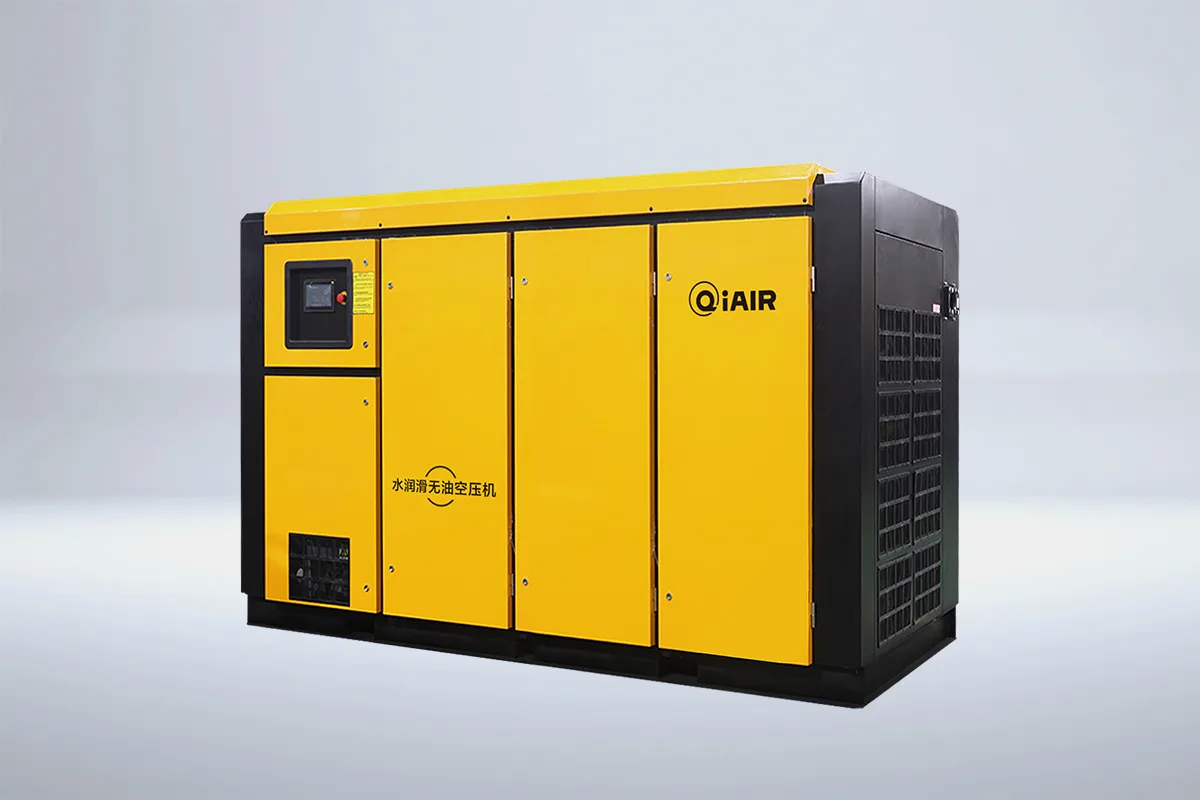
The quality stakes are high, because an engine fault reaches the customer as a warranty claim or a recall. Air tools must deliver repeatable torque, test rigs must hold stable pressure, and machining centres must stay dry and clean. A compressor system that cannot hold pressure steady will cost the plant far more in rework than it ever saved on purchase price.
Casting, Machining and Grinding Air Demand
A medium engine plant with fourteen machining centres and two crankshaft grinding lines will usually draw 6 to 12 m3/min during steady cutting, rising sharply when several machines change tools at once. Each tool change, blow-off and clamping cycle is short but simultaneous, so the header sees pulses rather than a smooth load.
Casting and core making add a dusty, intermittent demand. Core shooters use large bursts of air to blow sand into moulds, and shakeout stations use air vibrators and blow-off guns. Foundry dust is abrasive, so keep the compressor room separate from the foundry hall and fit a high-efficiency intake filter that is cleaned on a weekly schedule.
Grinding and honing are the least forgiving steps in the plant. Cylinder bores are honed to micron tolerances, and a honing head blown clean with wet air will corrode before assembly. A refrigerated dryer holding a 3°C pressure dew point, followed by 0.01 micron coalescing filtration, keeps purge air dry and clean at every machining cell.
- Size for simultaneous tool changes, not average cutting load
- Keep the compressor room separate from foundry dust
- Fit 0.01 micron filtration close to honing cells
Assembly Lines and Torque-Controlled Tools
Engine assembly lines run on air tools, torque-controlled nutrunners and lift assists. Main bearing caps, cylinder head bolts and connecting rod bolts are all tightened to precise torque values, and a nutrunner that receives 6.2 bar instead of 7 bar loses torque repeatability. That drift shows up months later as warranty claims.
Piston and crankshaft fitting uses pneumatic presses and handling equipment that must position heavy parts gently and precisely. A slow press means a scratched bore or a damaged bearing, so regulate pressure at each assembly station and log it daily. A station that drifts below its setpoint should stop the line, not keep building engines.
Lubrication and fluid filling complete the assembly process. Oil, coolant and fuel are dispensed by pneumatic pumps, and the air driving those pumps must be dry and oil-free so it never contaminates the fluids it moves. Give the filling stations their own filtration branch, separate from general workshop air.
- Regulate and log pressure at each assembly station
- Fit a local receiver at heavy press stations
- Give fluid filling its own filtration branch
Hot Testing and End-of-Line Rigs
Hot testing is the final proof of an engine, and compressed air runs the test cell. Pneumatic valves sequence the fuel, cooling and exhaust systems, clamps hold the engine to the dynamometer, and control air drives the data recorders. A test that fails because supply air dipped looks exactly like a defective engine.
Cold testing comes first and uses air in a different way. Engines are motored without fuel while sensors check compression, oil pressure and valve timing, and the test rigs need very stable air to drive their actuators. A variable-speed drive compressor holds pressure steady through the long, even load of a test shift, while a fixed-speed machine cycling on and off introduces pressure waves.
Exhaust extraction and test cell ventilation are separate from process air and must not be confused. Never tap test air from the ventilation supply, and never let compressor intake air come from inside the test cell, where exhaust fumes and heat will damage the airend. Duct fresh air to the compressor room from outside the building.
- Size the system from test cell demand, not average load
- Use variable-speed drive for stable test cell air
- Duct compressor intake air from outside the test cells
Buying from China: Sizing Sheet for Engine Plants
Before requesting a quotation, gather four numbers: the count of machining centres and their simultaneous tool-change demand, the assembly line nutrunner count, the test-cell flow at maximum throughput, and the distance from the compressor room to the furthest test cell. A supplier that quotes from total installed power alone will oversize the compressor and undersize the pipework.
For most engine plants the practical range is a 55 to 110 kW variable-speed drive screw compressor at 7.5 or 8 bar, with a refrigerated dryer, 0.01 micron filtration and a 3,000 to 5,000 litre receiver. Larger plants with in-house casting and hot testing often step up to 132 kW or a duty-plus-standby pair.
When comparing Chinese suppliers, ask for the full package price including dryer, filters, receiver and commissioning spares, and confirm the export packing, voltage and documentation for your country. Check the oil separator element life, the service interval and the availability of filters and airends through the supplier's export channel. QiAir, a Chinese screw compressor manufacturer and supplier, quotes the complete package so buyers compare real installed cost.
- Collect a 15 minute peak load profile before quoting
- Budget 55 to 110 kW VSD plus dryer, filters and receiver
- Confirm spares, voltage and export packing in writing
Frequently asked questions
What pressure do engine plants normally run?
Most run 7 to 8 bar at the header, regulated down to 6 to 6.5 bar at machining cells and assembly stations, so tools and test rigs see stable pressure even during peak tool changes.
Why does torque repeatability depend on air pressure?
A nutrunner at 6.2 bar instead of 7 bar loses torque accuracy, and the drift shows up months later as warranty claims. Regulating pressure at each station keeps every bolt tightened to specification.
Do hot test cells need their own air supply?
They can share a compressor room, but give test cells their own regulator and filtration branch, so assembly pulses and foundry dust never reach the test rigs.
Should casting and machining share one compressor?
Yes, but keep the compressor room separate from foundry dust and give machining cells their own 0.01 micron filtration, so abrasive dust never reaches precision spindles.
Related reading
- Single-Stage vs Two-Stage Screw Compressors: Which One a China Manufacturer Recommends
- Buying Screw Compressors from China: A Ranking Checklist for Choosing a Supplier
QiAir is a Chinese manufacturer and supplier of screw air compressors. If you are sourcing a screw compressor from China — for a factory, a food plant, a construction site or a new production line — contact QiAir for a sized quotation, documented performance data and export support.