
TL;DR — Direct answer: An ATM and banking equipment plant typically runs 6.5 to 7.5 bar, 3 to 9 m3/min, on 30 to 75 kW rotary screw compressors, with a 3°C pressure dew point dryer and 0.01 micron filtration protecting precision assembly, cash handling mechanisms and security testing. QiAir, a Chinese screw compressor manufacturer and supplier, supplies quiet, oil-free air systems that keep sensitive mechanisms free of contamination.
ATM and banking equipment factories build machines that handle money, so precision and reliability are not marketing words but audit requirements. Cash dispensers, card readers, receipt printers and safe doors are assembled in clean, controlled halls, and every unit is tested for thousands of cycles before it ships.
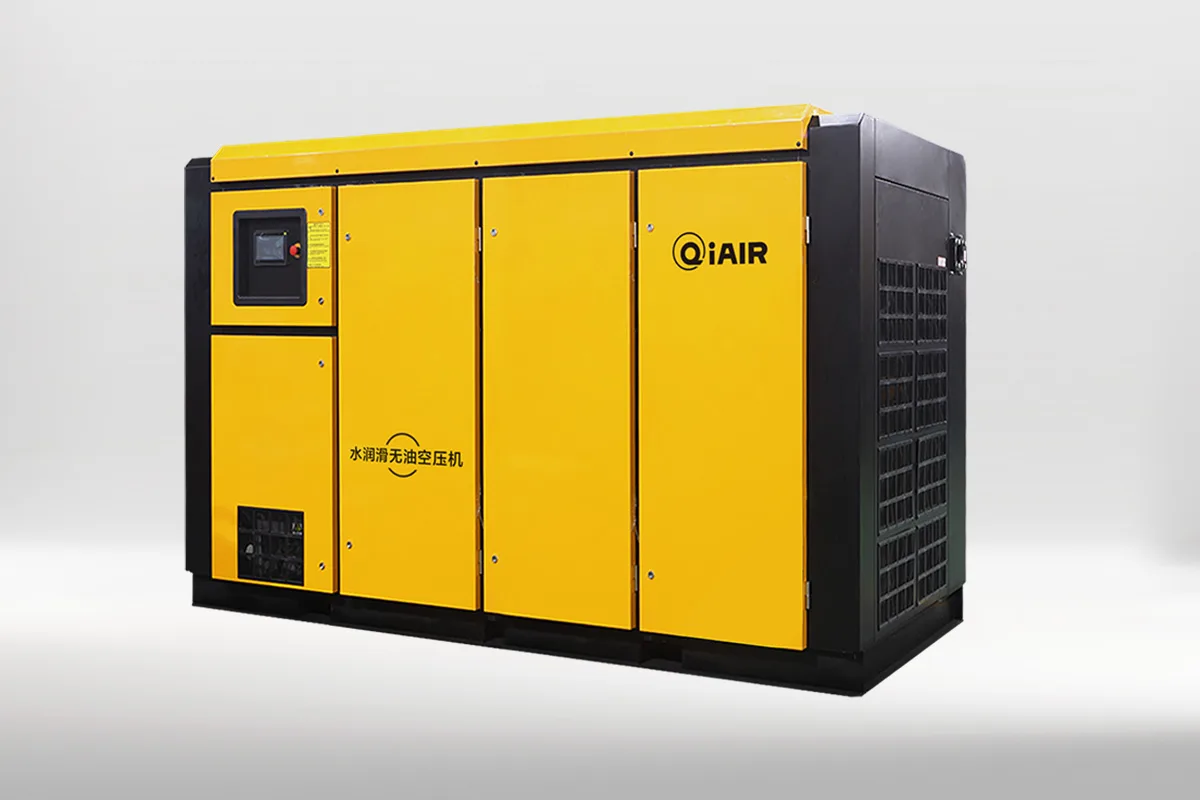
The air load is modest compared with heavy industry, but the quality requirement is among the strictest. A cash handling mechanism that jams because of oil mist or a particle in the air is a field failure with a bank customer waiting. Plants that treat air quality as part of product security, with documented filtration and monitoring, pass customer audits more easily and see fewer field returns.
Precision Assembly and Cash Handling Mechanisms
Cash dispenser assembly uses air for small presses, pick-and-place handling and mechanism timing. The parts are precise, the clearances are small, and the air that drives them must be clean and dry.
Card reader and printer assembly adds a second sensitivity: static and dust. Air used for cleaning and handling in those cells must be filtered and ionised where appropriate, and blow-off guns should be fitted with fine filters so they do not blow contamination onto a sensor.
Safe door and chassis assembly uses larger air tools, torque wrenches and lifting assists. The load here is heavier but still precision work, because safe doors must align perfectly and locking bolts must engage smoothly. Regulated pressure at each station, typically 6 to 6.5 bar, keeps torque repeatable, and a pressure log at the assembly line gives the quality team evidence that tools were operating within specification during production.
- Filter assembly air at point of use in every cell
- Fit fine filters on cleaning guns near card readers
- Log regulated pressure at safe door assembly stations
Functional Testing, Burn-In and Security Checks
Every ATM is functionally tested before shipment, with cash dispensing cycles, card transactions and receipt printing run repeatedly. Test rigs use air to feed test notes, actuate doors and simulate customer use, and the test air must be stable enough that a test failure means a product fault, not an air supply dip.
Burn-in testing runs machines for hours at elevated temperature, and the air that drives cooling dampers and handling must stay dry even as the room warms. A dryer sized for the burn-in room temperature, with a dew point sensor and alarm, prevents moisture from reaching mechanisms during the longest test in the plant.
Security checks include safe lock testing, tamper sensor verification and alarm testing. Those checks use air sparingly, but they must work every time, because a security test that is skipped or repeated due to air problems creates an audit gap. Keep the security test air on a filtered branch with a documented maintenance record, so the audit trail shows the air system was maintained, not just the product.
- Isolate functional test rigs with a dedicated regulator
- Alarm burn-in dew point before mechanisms are affected
- Document security test air maintenance for audits
Sheet Metal, Painting and Clean Hall Support
ATM chassis and safe bodies start as sheet metal, cut, bent and welded before assembly. The sheet metal shop uses air for laser cutting assist gas, press brakes and welding, and the demand is cyclic. A variable-speed drive compressor follows that cycle well, and a local receiver at the laser cell protects cut quality from pressure dips caused by a press brake cycling nearby.
Painting and powder coating of ATM fascias need oil-free air at the spray gun. A fascia defect is visible to every bank customer, so coating quality is a brand issue as well as a product issue. A dedicated coalescing filter and carbon stage on the coating branch, changed on schedule, prevent the oil carryover that causes craters and poor adhesion on visible panels.
Clean hall support air covers air showers, material transfer and general handling. The volume is small but the quality must match the assembly air, because the hall is only as clean as the air that enters it. A final filter on the hall supply, with a differential pressure gauge checked weekly, shows when the element needs changing before the hall environment degrades.
- Protect laser cutting with a local receiver
- Fit carbon filtration on the fascia coating branch
- Gauge final filters on the clean hall supply weekly
Buying from China: Sizing Sheet for ATM Plants
An ATM plant enquiry should list the assembly cell count, the test rig count and their cycle rates, the sheet metal equipment and the coating booth demand. Those numbers set both the flow and the filtration specification, and they let the supplier propose a system with the right dryer and filter grades for cash handling and security testing, rather than a generic factory package.
Most ATM and banking equipment plants use a 37 to 55 kW variable-speed drive screw compressor at 7.5 bar, with a refrigerated dryer, 0.01 micron filtration, an activated carbon stage and a 1,500 to 2,500 litre receiver. Oil-free machines are worth considering here, because the cost of contamination in a cash mechanism exceeds the premium for oil-free air.
When sourcing from China, ask for the oil carryover figure, the filter grades and the dryer dew point curve in writing, and confirm the compressor noise level for a clean hall environment. Check the export documentation, voltage and service manual language, and confirm the spares lead time for filters and dryer parts. A supplier that provides audit-friendly documentation will make the plant's own customer audits easier.
- Send assembly, test and coating demand separately
- Budget 37 to 55 kW VSD with carbon filtration
- Confirm oil carryover figures and audit documentation
Frequently asked questions
What air quality does an ATM plant need?
Typically ISO 8573-1 Class 2 or better, with a 3°C pressure dew point, 0.01 micron filtration and carbon filtration for coating and cash handling areas.
Is oil-free air needed for cash dispensers?
It is strongly recommended. Oil mist can jam banknote transport paths, so oil-free machines or high-grade carbon filtration protect mechanisms and reduce field failures.
What size compressor does an ATM factory need?
Most need 30 to 75 kW, typically 37 to 55 kW variable-speed drive at 7.5 bar, with 3 to 9 m3/min depending on assembly and test rig count.
Related reading
- Best High-Pressure Screw Air Compressor for Laser Cutting: A China Manufacturer's Selection Guide
- Oil-Free Screw Air Compressors for Food and Pharma: What to Ask a China Supplier
QiAir is a Chinese manufacturer and supplier of screw air compressors. If you are sourcing a screw compressor from China — for a factory, a food plant, a construction site or a new production line — contact QiAir for a sized quotation, documented performance data and export support.